

Quick answer: Water on the brain in elderly adults is the everyday term for hydrocephalus — a build-up of cerebrospinal fluid, not water, inside the brain. In older adults it usually means normal pressure hydrocephalus, which causes walking difficulty, memory problems and bladder urgency. It is often treatable with a shunt.
Key Takeaways
- The “water” is cerebrospinal fluid, a normal fluid the brain produces every day.
- In seniors it most often means normal pressure hydrocephalus (NPH).
- Walking usually changes before memory does.
- It is not the same as a stroke, tumour or dementia, though it can look like all three.
- Treatment with a shunt can restore mobility and independence.

A woman once told me she almost laughed when the term first came up, in a hallway conversation with her husband’s doctor. “Water on the brain” sounded like something from an old wives’ tale, not a diagnosis for a sharp, seventy-one-year-old man who still did the crossword every morning.
It had started with his balance. He began holding onto furniture as he crossed a room he had walked through unaided for thirty years. Then he stopped finishing sentences partway through — not because he forgot the words, but because he seemed to lose interest in reaching the end of them. She assumed stress, then age, then, quietly, something worse.
The phrase the doctor actually used — normal pressure hydrocephalus — is stranger and more precise than “water on the brain”, and understanding what it really means was the first thing that helped her stop guessing.
What “Water on the Brain” Actually Means
The phrase is old, common, and slightly misleading. There is no water involved. The fluid is cerebrospinal fluid (CSF), which the brain produces continuously to cushion and protect itself.
Your brain makes roughly 500 ml of CSF a day and absorbs the same amount. When absorption falls behind, fluid collects in the ventricles — the brain’s fluid-filled chambers — and they enlarge. That is hydrocephalus.
In children the skull can expand, so the head grows. In older adults the skull is fixed, so the pressure effects show up as changes in walking, thinking and bladder control instead.
Water on the Brain in Elderly Adults: What Families Notice First
This was precisely her husband’s pattern, though it took her months to see it as a pattern rather than a string of unrelated bad days.
Rarely a dramatic event. Usually a series of small changes that get explained away.
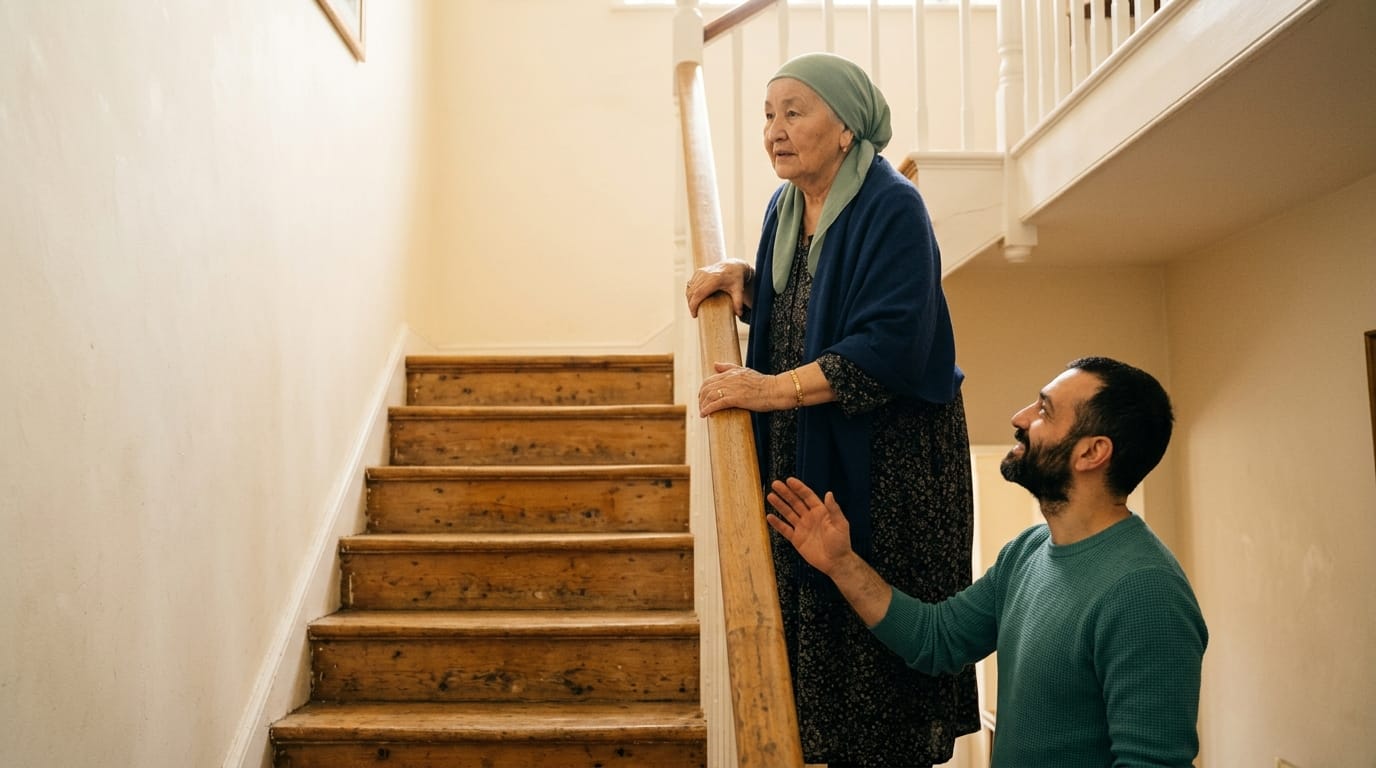
A parent stops going upstairs. They hold the wall in the hallway. They take longer to answer a question. They have an accident and are embarrassed. Each is attributed to age.
The pattern is what matters. When mobility changes before memory, and both are progressing over months, that combination deserves a specific medical question rather than acceptance. We cover this specific walking pattern, and how it differs from ordinary age-related unsteadiness, in our guide to NPH gait changes.
- Shuffling, wide-based walking that looks cautious
- Difficulty turning around without taking several small steps
- Falls, often backwards
- Slower thinking and reduced initiative
- Urinary urgency progressing to accidents
- Withdrawal from activities they previously enjoyed
Why It Is So Often Missed
Because every individual symptom has a more common explanation. Unsteadiness gets blamed on arthritis or eyesight. Slowness gets called ageing. Incontinence gets treated by a continence service without anyone asking why it started.
The Hydrocephalus Association and Alzheimer’s Association both note that a large majority of NPH cases go unrecognised or untreated. Estimates suggest around 800,000 older Americans may be affected, with more than 80% undiagnosed.
This is why families raising the question directly makes a genuine difference.

How Doctors Investigate It
The first step is usually a CT or MRI scan to look at the ventricles. Enlarged ventricles that are out of proportion to brain shrinkage point towards hydrocephalus rather than atrophy.
Because enlarged ventricles alone are not conclusive, doctors combine imaging with the clinical picture. A cerebrospinal fluid tap test may follow — removing a small volume of fluid and re-testing walking to see whether it temporarily improves.
Some centres use extended lumbar drainage over several days when the picture is unclear, as it can be more informative than a single tap.
What Treatment Involves
The main treatment is a shunt: a thin tube that drains excess fluid from the brain to the abdomen, where it is absorbed. It is placed under general anaesthetic and usually involves a short hospital stay.
Improvement is most reliable for walking. Memory and continence may improve less, particularly if symptoms have been present for years. Realistically, the earlier the treatment, the better the expected gain.
Age alone does not rule someone out. Suitability depends on general health and how much the symptoms are affecting daily life. We go into the real-world outcomes of shunt surgery after 65, including what the research actually shows about recovery odds, in this dedicated guide.

Questions to Ask the Doctor
- Ask: could this be normal pressure hydrocephalus?
- Ask: has a brain scan been done to look at the ventricles?
- Ask: does it matter that the walking changed before the memory?
- Ask: would a tap test or lumbar drain trial be useful here?
- Ask: who assesses whether a shunt is appropriate at this age?
- Ask: what improvement would be realistic if a shunt were placed?
Frequently Asked Questions
What does water on the brain mean in the elderly?
It means hydrocephalus — a build-up of cerebrospinal fluid in the brain’s ventricles. In older adults this is usually normal pressure hydrocephalus, which causes difficulty walking, slowed thinking and bladder problems rather than the severe headaches seen in children.
Is water on the brain in seniors treatable?
Often yes. A shunt drains the excess fluid and many people improve, particularly in walking and mobility. Results are generally better when treatment happens earlier, before symptoms have been present for several years.
What is the life expectancy with water on the brain in elderly patients?
Normal pressure hydrocephalus itself is not usually life-shortening when treated. The greater risks come from falls and loss of independence caused by untreated symptoms. Life expectancy depends far more on overall health and other conditions.
Is water on the brain the same as dementia?
No, though it is frequently mistaken for it. Dementia involves progressive loss of brain tissue and is not reversible. Normal pressure hydrocephalus is a fluid problem and can improve with surgery, which is why distinguishing the two matters so much.
Can water on the brain in the elderly be cured without surgery?
There is no reliable medication that restores normal fluid absorption. Some people with mild symptoms are monitored rather than operated on, but for those significantly affected, a shunt remains the only established treatment.
Her husband had his shunt placed six weeks after the diagnosis was confirmed. His balance came back almost immediately — she remembers him walking to the mailbox alone on the third day and standing in the driveway afterward, oddly proud of himself. His sentences took longer to return fully, and some mornings are still slower than others. She has stopped expecting the old version of him to come back all at once, and started noticing the good days instead.
If a phrase like “water on the brain” has come up in your own family and it sounds too strange to be real, it is real — and it is far more treatable than most of the alternatives anyone will suggest first.
Related Reading
- Normal Pressure Hydrocephalus: 7 Signs Families Miss
- NPH or Dementia? How Doctors Tell the Difference
- Hydrocephalus in Adults: Symptoms and Treatment
Bibliography
- Hydrocephalus Association. What is Normal Pressure Hydrocephalus? Available at: hydroassoc.org
- Alzheimer’s Association. Normal Pressure Hydrocephalus (NPH). Available at: alz.org
- Time Course of Symptoms in Normal-Pressure Hydrocephalus: A Systematic Review. Available at: PMC12293206