
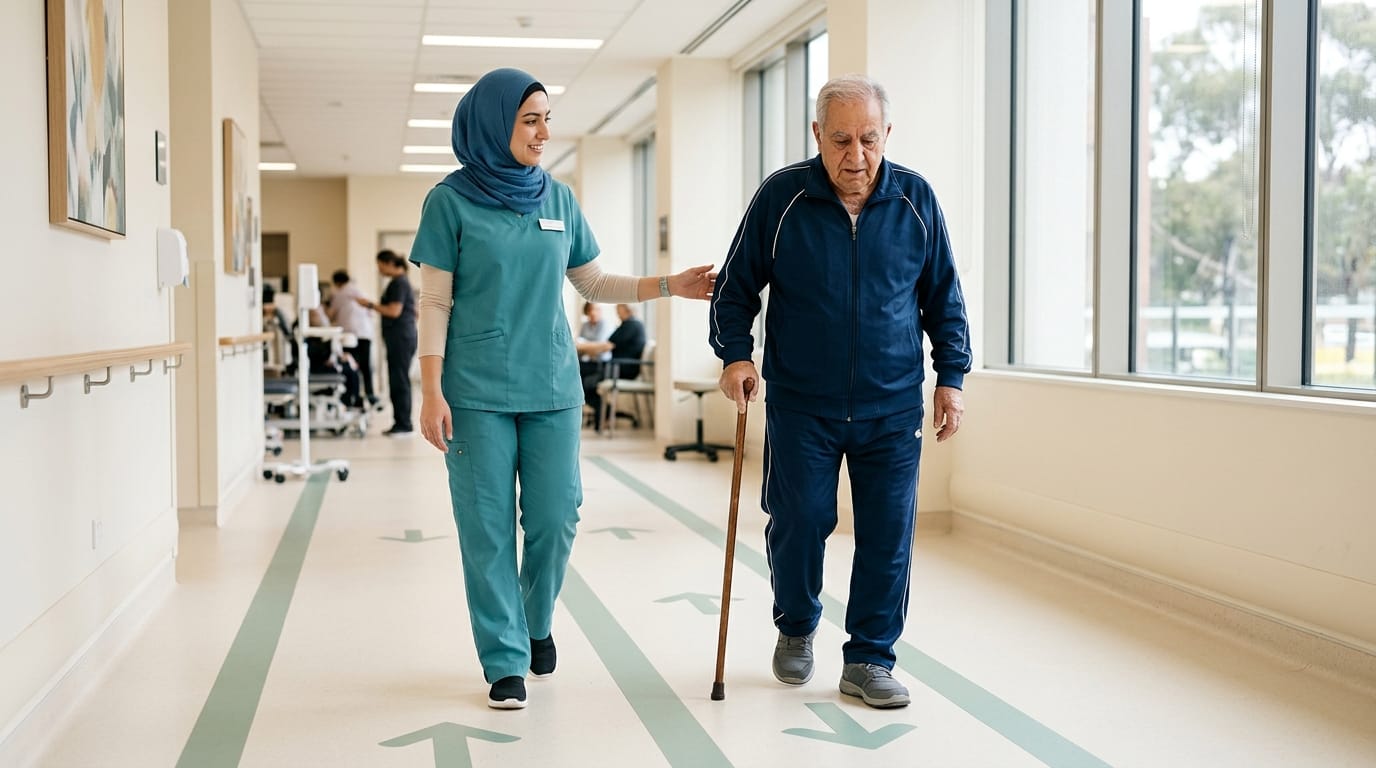
Quick answer: NPH gait changes typically appear before memory or bladder symptoms, because the nerve fibres controlling the legs run closest to the enlarged ventricles. The result is a “magnetic” gait — short shuffling steps, feet close to the floor, a wide stance, and difficulty turning without several small steps.
Key Takeaways
- Leg nerve fibres sit nearest the ventricles, so they are stretched first.
- The gait is wide-based and shuffling, unlike the narrow-based gait of Parkinson’s.
- Turning is where the abnormality is most visible.
- Gait apraxia is present from the earliest stage of idiopathic NPH.
- Walking is also the symptom most likely to improve after a shunt.
A physiotherapist I spoke with described a patient sent to her for “general balance issues” — the kind of vague referral she gets a dozen times a month. He was in his late seventies, otherwise healthy, and had started falling at home. Nothing on his chart suggested anything more specific than ageing.
Within the first five minutes of watching him walk across her clinic, she suspected it was not ordinary imbalance. His feet did not lift so much as slide, as though the floor had become slightly magnetic. Turning around took him four separate small steps instead of one pivot. She had seen this exact pattern before, in a handful of older patients, and it was never just balance.
She sent a short note back to his GP, describing the gait in detail and naming normal pressure hydrocephalus as a possibility. It is a small example of something worth knowing: physiotherapists often spot NPH gait before anyone else does, simply because they are the ones who actually watch people walk.
NPH Gait: Why Walking Is Affected Before Anything Else
The brain’s nerve fibres are arranged in a particular order. Those carrying signals to the legs run closest to the ventricles; those serving the arms and face sit further out.
When ventricles enlarge, they stretch the nearest fibres first. Consequently, leg control is disrupted before arm control, and walking deteriorates before most other functions.
This anatomical detail is the reason the symptom order is so consistent, and why that order is diagnostically useful.
This is the anatomical reason her patient’s balance problem was never really about balance at all.
What NPH Gait Actually Looks Like
Clinicians often call it a magnetic gait, because the feet appear stuck to the floor as though pulled down.
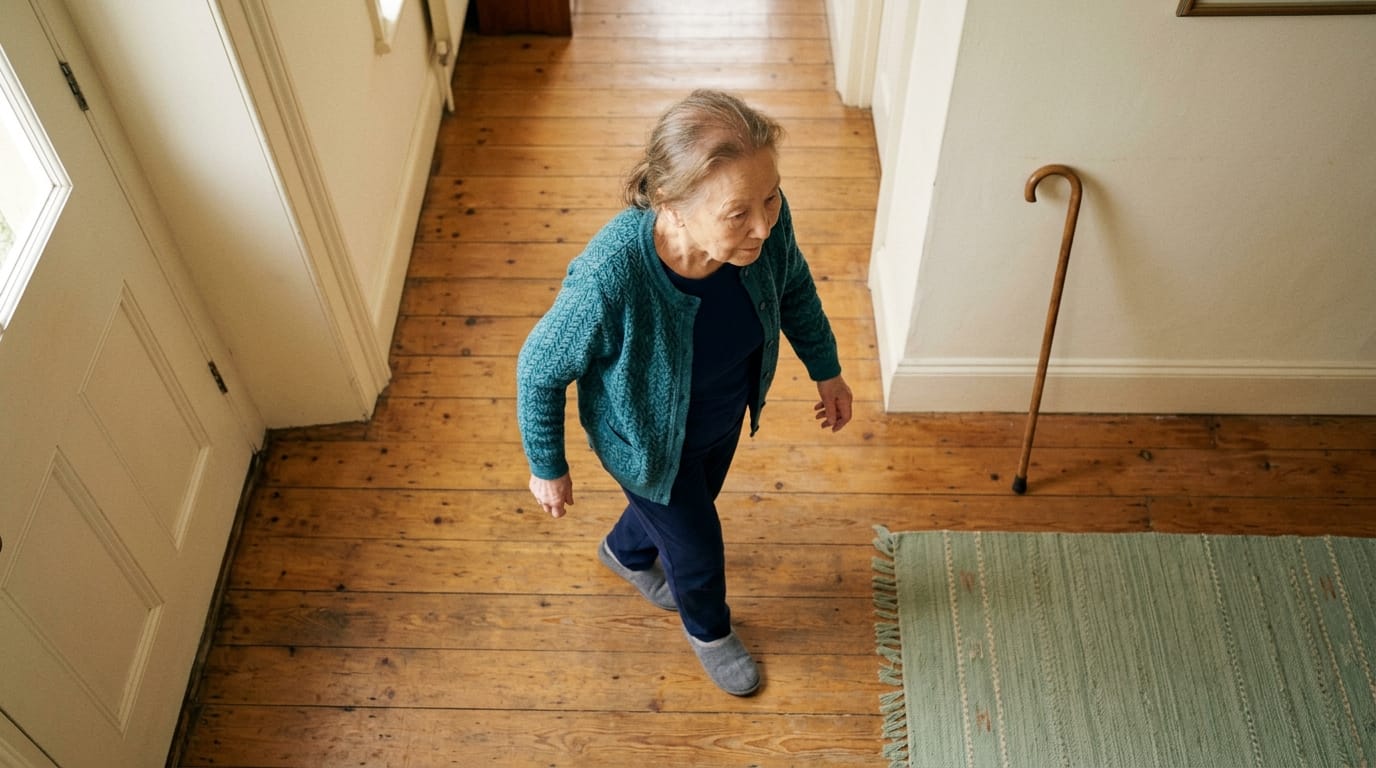
- Short steps, sometimes only a few centimetres
- Feet barely lifting from the ground
- Wide stance, feet further apart than usual
- Difficulty starting to walk — hesitation before the first step
- Turning broken into several small shuffling steps
- Freezing in doorways or when changing direction
How It Differs From Parkinson’s and Ordinary Ageing
Parkinson’s disease also produces shuffling and hesitation. However, Parkinson’s gait is typically narrow-based, with a stooped posture, reduced arm swing on one side, and often a resting tremor.
NPH gait is wide-based, and the person usually stands more upright. Additionally, arm swing tends to be preserved in NPH, which is a useful bedside distinction.
Ordinary age-related slowing is different again. Older adults naturally walk more slowly, but they do not usually develop a wide stance, freezing, or the multi-step turn.
What the Research Shows
A 2022 study in Fluids and Barriers of the CNS used wearable inertial sensors to measure gait objectively in people with idiopathic NPH. Participants completed a Timed Up and Go test and an 18-metre walk at baseline, three days after a cerebrospinal fluid tap test, and six months after shunt surgery.
The study confirmed that gait apraxia is present from the earliest manifestation of idiopathic NPH, and examined how well the tap test predicts who will benefit from surgery. Notably, the researchers described the predictive capacity of the tap test as still under debate.
For families, the practical message is that objective gait measurement — including simple timed walking tests — gives better evidence than impressions alone.
What This Means for Your Family
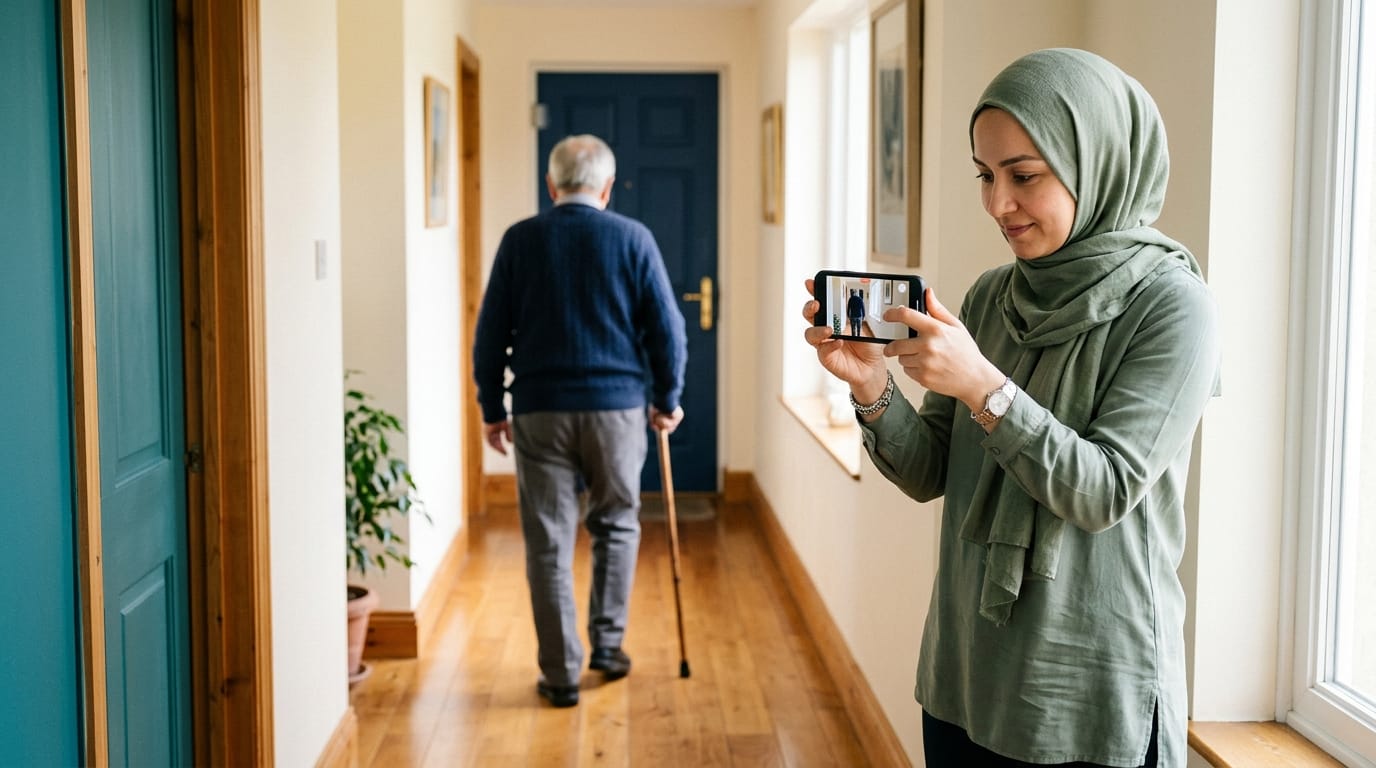
Record a video. Film your relative walking about ten metres down a hallway, then turning around and walking back. The turn is the part clinicians most want to see.
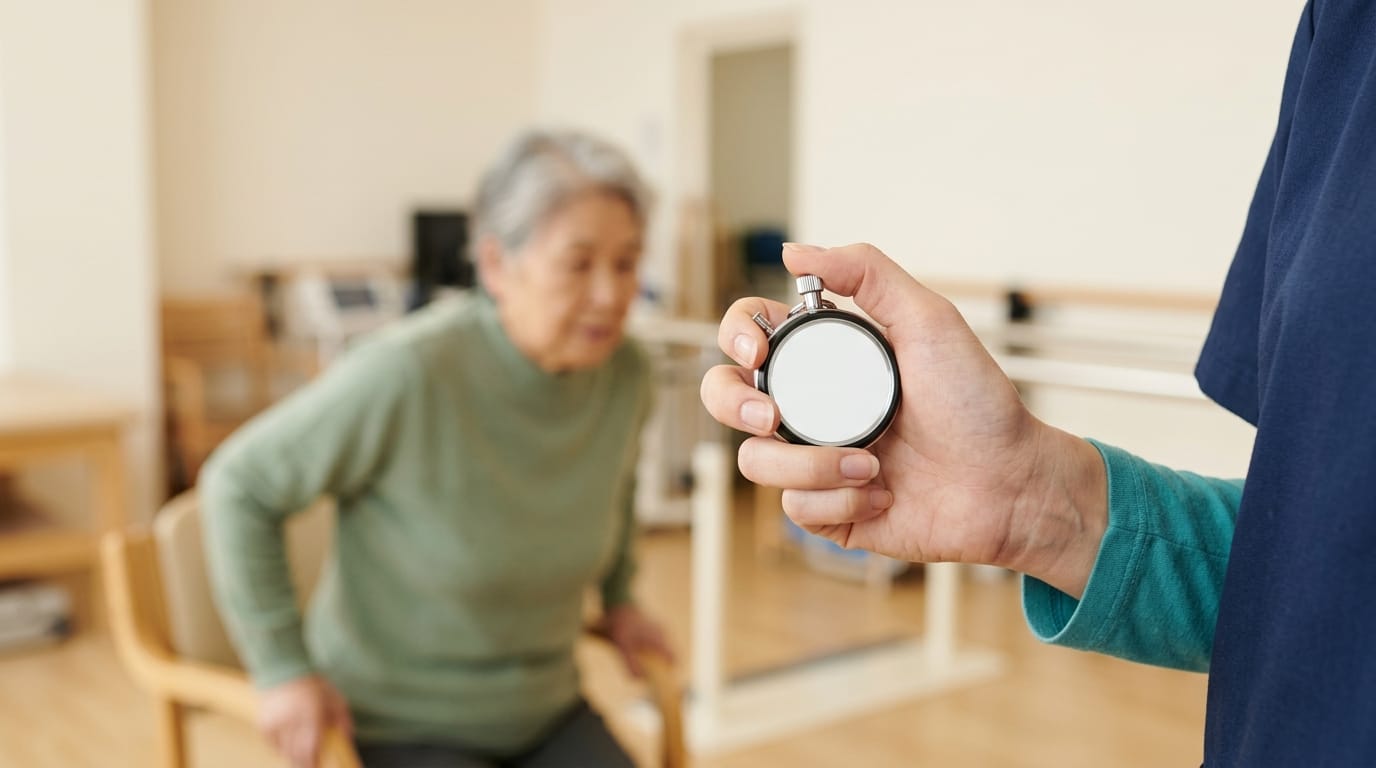
Time it. A simple stopwatch measurement of how long it takes to stand, walk three metres, turn and sit down again gives a number that can be repeated after treatment.
Keep those recordings. If a tap test is done, the same video and timing afterwards makes improvement far easier to judge than memory alone.
Frequently Asked Questions
What does NPH gait look like?
NPH gait is slow, shuffling and wide-based, with the feet staying close to the floor as though magnetised. Starting to walk is difficult, and turning takes several small steps rather than one smooth pivot. Posture usually remains upright.
Why does NPH affect walking first?
The nerve fibres controlling the legs run closest to the brain’s ventricles. When the ventricles enlarge, these fibres are stretched before those serving the arms or higher thinking, so leg function is disrupted earliest.
Can walking improve after NPH treatment?
Yes. Walking is the symptom most likely to improve after shunt surgery, and improvement can be substantial. Gains are generally greater when surgery happens earlier, before the gait problem has been present for years.
How is NPH gait tested?
Doctors use timed walking tests such as the Timed Up and Go and a fixed-distance walk. Some centres use wearable motion sensors for objective measurement. Walking is usually measured before and after a cerebrospinal fluid tap test.
Is NPH gait the same as Parkinson’s gait?
No. Both cause shuffling, but Parkinson’s gait is narrow-based with stooped posture, reduced arm swing and often tremor. NPH gait is wide-based with preserved arm swing and a more upright posture.
Her patient’s shunt was placed two months after that referral note. His physiotherapist saw him again during his post-operative rehabilitation, walking — her word — “almost embarrassingly normally” down the same hallway where she had first watched him shuffle. Not every referral ends this way, but she still keeps his gait video, with his permission, to show trainee physiotherapists what to look for.
If someone you love has been sent for “balance issues” and nothing more specific, it is worth asking whether anyone has actually described how they walk, in detail, rather than simply noting that they fall.
Related Reading
- Normal Pressure Hydrocephalus: 7 Signs Families Miss
- NPH or Dementia? How Doctors Tell the Difference
- Balance and Walking Exercises After Shunt Surgery
Bibliography
- Gait apraxia evaluation in normal pressure hydrocephalus using inertial sensors: clinical correlates, ventriculoperitoneal shunt outcomes, and tap-test predictive capacity. Fluids and Barriers of the CNS. 2022. Available at: PMC9219204
- Gait apraxia in normal-pressure hydrocephalus. Neurology. Available at: neurology.org
- Hydrocephalus Association. What is Normal Pressure Hydrocephalus? Available at: hydroassoc.org