Key Takeaways
- Yes.
- Improvement varies.
- If your child shows sudden worsening of eye alignment, complains of double vision, has eyes that move in abnormal directions, or if home exercises produce headache or significant distress, a paediatric ophthalmologist should assess them.
- The sunset sign is a downward deviation of the eyes caused by pressure on the brain structures controlling upward gaze.
Eye Tracking Exercises for Children: Vital Brain Recovery Techniques
Key Takeaways
- Eye movement problems are common after brain infection, hydrocephalus, and neurological illness — the eyes are controlled by brain pathways that can be disrupted by inflammation and pressure
- Targeted visual exercises can help retrain eye coordination, tracking, and synchronisation — often producing visible improvement within days to weeks of consistent practice
- These exercises complement medical treatment — they are not a replacement for neurology follow-up, but a daily practice that supports recovery between appointments
Quick answer: Eye movement problems are common after brain infection, hydrocephalus, and neurological illness — the eyes are controlled by brain pathways that can be disrupted by inflammation and pressure. Targeted visual exercises can help retrain eye coordination, tracking, and synchronisation — often producing visible improvement within days to weeks of consistent practice.
His eyes were not working together.
After the brain infection and the weeks of pressure building inside his skull, they moved independently — one drifting while the other looked forward. When he tried to focus on my face, something about the effort showed on his. Like two systems trying to synchronise that had forgotten how.
We had medicine for the infection. We had medicine for the seizures. Nobody gave us exercises for the eyes.
I found them — piece by piece — in research papers, in vision therapy resources, in conversations with parents who had been through similar experiences. What I learned is that the visual system has remarkable capacity to recover when given the right input, consistently, over time.
Within a week of starting these exercises, his eyes began to synchronise. Not completely. Not overnight. But the change was visible — to us and to his neurologist.
This is what we did.

Why Brain Illness Affects Eye Movement
The eyes are controlled by six muscles each, coordinated by three cranial nerves, all reporting to brain centres that manage gaze direction, tracking, focusing, and the synchronisation of both eyes together.
When the brain experiences infection, inflammation, or increased pressure — the pathways controlling these muscles can be disrupted. The result can include:
- Strabismus — one or both eyes turning inward or outward
- Nystagmus — involuntary rhythmic eye movement
- Convergence insufficiency — difficulty keeping both eyes focused on a near object
- Tracking difficulties — struggling to follow a moving object smoothly
- Gaze paresis — difficulty moving the eyes in a specific direction
- The sunset sign — downward deviation of the eyes seen in hydrocephalus
These problems can appear suddenly following a neurological event and can improve significantly with targeted exercise and medical treatment working together.
Before Starting — Important Notes
Always discuss visual symptoms with your child’s neurologist first. Some eye movement problems in neurological illness require medical intervention before exercises are appropriate.
These exercises are suitable for children whose neurological condition is medically stable. Begin gently. Watch your child’s response — mild fatigue is expected, but headache, dizziness, or distress means stopping and resting.
Start with 2–3 minutes per session. Build gradually to 10–15 minutes as your child tolerates.
Consistency matters more than duration. Daily practice for five minutes produces better results than occasional longer sessions.
The 7 Eye Tracking Exercises
Exercise 1 — Smooth Pursuit Tracking
What it does: Trains the eyes to follow a moving object smoothly — the foundational skill for coordinated vision.
How to do it:
- Sit with your child at eye level, about 40cm away
- Hold a brightly coloured pen, toy, or your finger at their eye level
- Move it slowly and smoothly from left to right, covering about 30cm
- Ask your child to follow it with their eyes only — head stays still
- Repeat right to left. Then up to down. Then diagonally.
- 5 repetitions in each direction
Progress: Gradually increase the speed of movement as tracking improves. Add unpredictable direction changes.
Exercise 2 — Near-Far Focus Shifting
What it does: Trains the eye muscles that control focusing — weakened by neurological illness and disuse.
How to do it:
- Hold a small object (finger, sticker, small toy) 15cm from your child’s eyes
- Ask them to focus on it clearly for 3 seconds
- Point to an object across the room and ask them to focus on that for 3 seconds
- Return focus to the near object
- Repeat 10 times
Progress: Increase the contrast between near and far distances. Reduce the focusing time to 2 seconds to increase the speed demand.
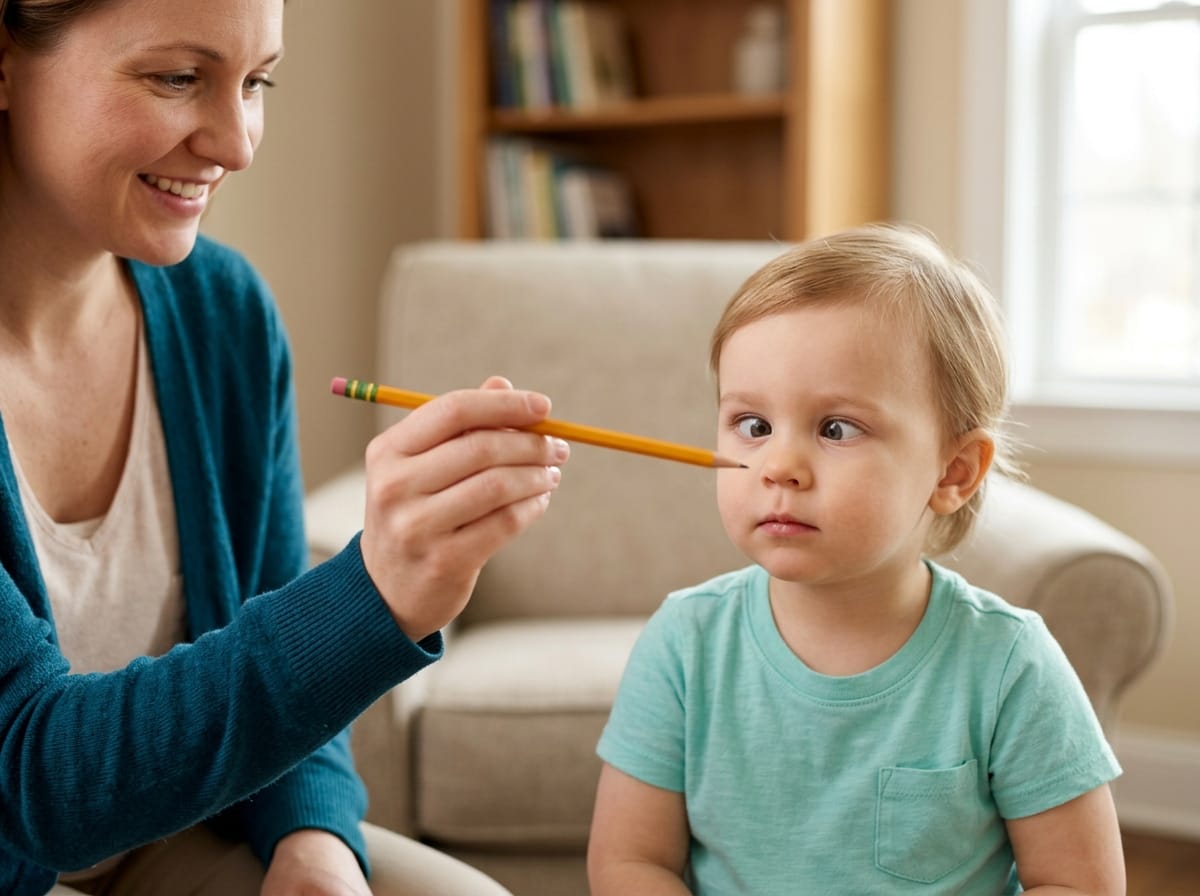
Exercise 3 — Pencil Push-Ups for Convergence
What it does: Directly trains eye convergence — the ability to turn both eyes inward together to focus on near objects. Convergence failure is one of the most common visual problems after brain illness.
How to do it:
- Hold a pencil or pen at arm’s length in front of your child’s nose
- Ask them to focus on the tip
- Slowly move the pencil toward their nose
- They should keep both eyes focused on the tip as it moves closer
- Stop if you see one eye drift outward — that is the point of breakdown
- Hold for 2 seconds at the closest point they can maintain focus
- Return slowly to arm’s length
- Repeat 10 times
The goal: Reduce the distance at which one eye drifts. Record progress weekly — you will often see clear improvement over 2–4 weeks.
Exercise 4 — Figure-8 Tracking
What it does: Challenges smooth pursuit in a more complex, unpredictable pattern — advancing from the basic left-right tracking of Exercise 1.
How to do it:
- Draw a large figure-8 on paper or tape one on a wall at eye height
- Ask your child to follow a finger or pointer tracing the figure-8 with their eyes only
- Head stays still throughout
- 5 full figure-8 repetitions clockwise, then 5 counter-clockwise
Progress: Increase the speed. Use a smaller figure-8 for more precision demand.
Exercise 5 — Saccade Practice
What it does: Trains saccades — the fast, precise eye jumps used when reading, scanning a room, and looking between objects. These are often disrupted after neurological illness.
How to do it:
- Place two small stickers or objects about 40cm apart at your child’s eye level
- Call out “left” or “right” — your child moves only their eyes to look at that target
- Alternate randomly: left, right, left, left, right
- The movement should be fast and precise — directly to the target, not drifting
- 20 repetitions
Progress: Increase to three targets. Add a third colour or position. Increase the speed of calling.
Exercise 6 — Brock String Convergence
What it does: One of the most effective tools used in formal vision therapy — it makes the brain’s eye coordination system visible and trainable.
What you need: A piece of string approximately 1.5 metres long with three beads or knots at different distances along it.
How to do it:
- Tie one end of the string to a fixed point at your child’s eye level
- Your child holds the other end gently at their nose
- Ask them to focus on the nearest bead
- When focused correctly, they should see two strings forming a V shape meeting at the bead
- Move focus to the middle bead, then the far bead
- Practise shifting focus between the three beads, 10 repetitions each
Progress: This exercise looks simple but demands significant visual coordination. 3–5 minutes daily produces measurable convergence improvement within 2–4 weeks.
Exercise 7 — Visual Scanning Grid
What it does: Trains the broad scanning ability needed for reading, navigating space, and visual attention — often reduced after brain illness.
How to do it:
- Draw a simple grid of 25 numbers (1–25) arranged randomly in a 5×5 grid
- Ask your child to find and point to each number in order as fast as possible
- Time them and record the result
- Repeat daily — the improvement in time across weeks shows visual scanning progress directly
Progress: Smaller numbers, more numbers, or adding letters alongside numbers all increase the challenge.

Tracking Progress Week by Week
Keep a simple weekly note of:
- Which exercises your child can complete without strain
- How long they can sustain tracking before fatigue
- Whether both eyes are moving together more consistently
- Any specific improvement observed — such as the eyes being aligned more often
Share these notes with your neurologist at follow-up appointments. Documented improvement helps the medical team assess neurological recovery more accurately than clinical observation alone.
Questions to Ask Your Neurologist or Ophthalmologist
- Do you recommend formal vision therapy assessment alongside these home exercises?
- Are there specific visual symptoms in my child that suggest a particular exercise focus?
- How will we know if the visual problems are resolving — what signs should I look for?
- Should my child see a paediatric ophthalmologist in addition to the neurologist?
- Are any of my child’s medications likely to affect eye movement or visual processing?
Frequently Asked Questions About Eye Exercises After Brain Illness
Can eye exercises help after hydrocephalus or brain infection?
Yes. The visual pathways affected by brain pressure and inflammation have significant capacity to recover with targeted training. Eye tracking, convergence, and coordination exercises are used in formal vision therapy and can be adapted for home use. They work best when the underlying neurological condition is medically stable.
How quickly can eye coordination improve with exercises?
Improvement varies. Some children show visible synchronisation changes within one to two weeks of consistent daily practice. Others take longer. The Brock String and pencil push-up exercises tend to show measurable convergence improvement within two to four weeks in most children.
When should I see an eye specialist rather than doing home exercises?
If your child shows sudden worsening of eye alignment, complains of double vision, has eyes that move in abnormal directions, or if home exercises produce headache or significant distress, a paediatric ophthalmologist should assess them. Home exercises complement but do not replace clinical evaluation.
What is the sunset sign in hydrocephalus and can exercises help?
The sunset sign is a downward deviation of the eyes caused by pressure on the brain structures controlling upward gaze. It is a sign of elevated intracranial pressure. Medical treatment to reduce that pressure — not eye exercises — addresses the underlying cause. As pressure normalises, the sunset sign typically resolves. Eye exercises can then support the remaining coordination recovery.
Within a week of starting these exercises consistently, his eyes began to move together. Not perfectly — but the drift reduced, the synchronisation returned in moments first, and then in longer stretches.
His neurologist noticed at the next appointment. She asked what we had been doing differently.
I told her about the exercises. She wrote them down.
Recovery rarely comes from one direction. It comes from every direction at once — the medicine, the sleep, the exercises, the consistency. The eyes were one part of what was healing. But they were the part we could see most clearly.
That visibility mattered more than I expected it to.
These exercises are for children whose neurological condition is medically stable. Always consult your child’s neurologist and ophthalmologist before beginning vision exercises following brain illness. This article does not constitute medical advice. Read our full disclaimer: braincarepath.com/disclaimer/
Bibliography
- Scheiman M, Wick B. Clinical Management of Binocular Vision. 4th ed. Lippincott Williams & Wilkins; 2014.
- Convergence Insufficiency Treatment Trial Study Group. Randomized clinical trial of treatments for symptomatic convergence insufficiency in children. Arch Ophthalmol. 2008;126(10):1336-1349. Available at PubMed
- Stifter E, Burggasser G, Hirmann E, Thaler A, Radner W. Monocular and binocular reading performance in children with microstrabismic amblyopia. Br J Ophthalmol. 2005;89(10):1324-1329. Available at PubMed
- Ciuffreda KJ, Ludlam DP, Kapoor N. Clinical oculomotor training in traumatic brain injury. Optom Vis Dev. 2009;40(1):16-23.