

Quick answer: Flying is safe with a VP shunt — cabin pressure does not affect shunt function, and security scanners will not damage the valve. For epilepsy, the main risks are sleep disruption and missed medication doses rather than the flight itself.
Key Takeaways
- Cabin pressure does not affect shunt function.
- Airport scanners do not alter programmable valve settings.
- Carry medication in hand luggage, never checked baggage.
- Sleep disruption is the main seizure risk when travelling.
- Carry a written summary and your valve card.

A young woman told me her aunt cried, actual tears, when she announced she was backpacking through Southeast Asia for three months, six years after her epilepsy diagnosis. Not tears of excitement. Her aunt genuinely believed the trip was reckless, maybe dangerous, and said so more than once in the weeks before departure.
She understood the fear even as it frustrated her. She had spent two years, right after diagnosis, barely leaving her own city, half-convinced that travel and epilepsy were simply incompatible. What actually stopped her, in the end, was never a doctor telling her not to go. Nobody ever had. It was the accumulated weight of other people’s worry.
Flying With a Shunt
This is one of the most common worries and one of the most straightforward to answer.
Aircraft cabins are pressurised, and the modest pressure change does not meaningfully affect how a shunt drains. People with shunts fly routinely, including long-haul.
Airport security is equally fine. Walk-through metal detectors and body scanners do not change programmable valve settings. Strong magnets can, but these are not present in airport security systems.
What to Carry With a Shunt
- Your programmable valve card, if you have one
- A brief written summary — diagnosis, shunt type, surgery dates, hospital contact
- Details of your neurosurgical unit including out-of-hours number
- Travel insurance documentation that explicitly covers your condition
- Awareness of the nearest neurosurgical centre at your destination
Travelling With Epilepsy
The flight itself is rarely the problem. The disruption around it is.
Sleep deprivation is one of the most consistent seizure triggers, and travel attacks sleep from several directions at once: early departures, overnight flights, time zone shifts and unfamiliar beds.
Additionally, medication timing becomes confusing across time zones, and missed doses are a leading cause of breakthrough seizures.
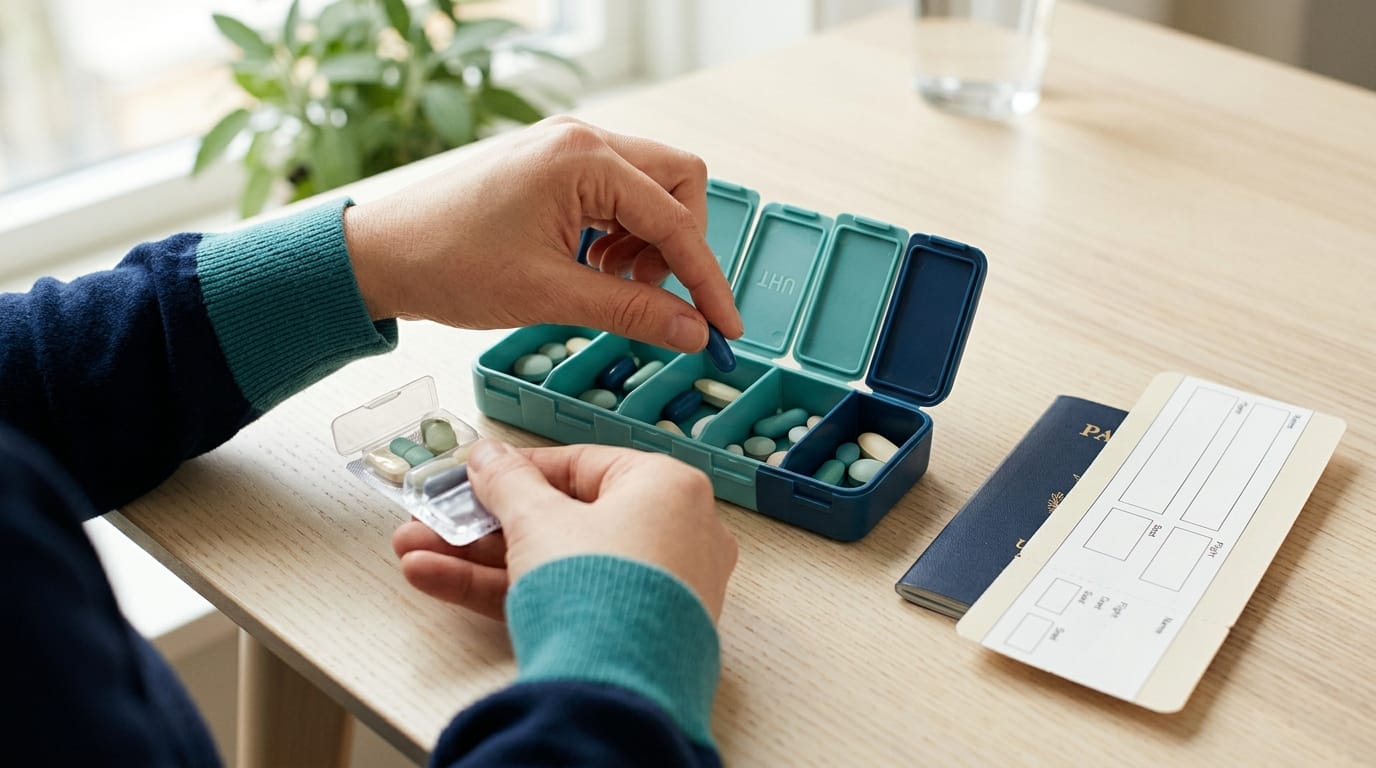

Managing Medication Across Time Zones
The single hardest logistical question, once she committed to going, was the one this section answers.
Keep it simple. For short trips of a few days, many people simply stay on home time for doses regardless of local time.
For longer stays, shift gradually — moving doses by an hour or two per day until aligned with local time. Ask your neurologist before travelling, particularly for medications with narrow timing windows.
- Always pack medication in hand luggage, never checked bags
- Bring more than you need, in case of delays
- Carry medication in original labelled packaging
- Bring a doctor’s letter listing your medications
- Set phone alarms for doses using home time initially
- Check whether your medication is legal at your destination — some are restricted
Practical Precautions Worth Taking
Tell someone you are travelling with what to do if a seizure occurs. Travel companions frequently have no idea.
Consider requesting an aisle seat, which makes reaching the toilet and moving around easier, and reduces the chance of being trapped if you feel unwell.
For long-haul travel, build in a recovery day at the destination rather than scheduling activity immediately on arrival. Fatigue accumulates and the risk is highest in the first days.

What This Means for You
Neither a shunt nor epilepsy is a reason to avoid travelling. Both are reasons to plan slightly more carefully than other people do.
The two highest-value preparations are packing medication in hand luggage and protecting sleep. Most travel problems in this group trace back to one of those two.
Get travel insurance that explicitly names your condition. Standard policies frequently exclude pre-existing conditions, and that exclusion is discovered at the worst possible moment.
Frequently Asked Questions
Can you fly with a VP shunt?
Yes. Aircraft cabin pressure does not affect shunt function, and people with shunts fly routinely including long-haul. Airport security scanners will not damage or reprogram the valve.
Do airport scanners affect programmable shunts?
No. Walk-through metal detectors and body scanners do not change programmable valve settings. Strong magnets can alter settings, but these are not used in airport security. Carry your valve card regardless.
Can you fly with epilepsy?
Yes. Flying itself does not trigger seizures. The main risks are sleep deprivation, disrupted medication timing and fatigue, all of which are manageable with planning. Always carry medication in hand luggage. Most children with well-controlled epilepsy go on to travel, work, and live full lives, a pattern we cover in more depth in our guide on whether a child can live a normal life with epilepsy.
How do I manage epilepsy medication across time zones?
For short trips, many people stay on home time for doses. For longer stays, shift doses gradually by an hour or two per day. Ask your neurologist first, particularly for medications with narrow timing windows.
What should I carry when travelling with a shunt?
Carry your programmable valve card, a written summary of your diagnosis and surgical history, your neurosurgical unit contact details, and travel insurance that explicitly covers your condition.
She built a simple spreadsheet before she left, mapping every dose to her home time zone regardless of where she was, and stuck to it for eleven weeks across six countries. She had one seizure the entire trip, on a night she had skipped dinner and slept badly, and handled it herself in a hostel with people who had been briefed, in advance, on exactly what to do. Her aunt has since asked, twice, for travel advice for a friend’s child with epilepsy.
If a diagnosis has made you or someone you love smaller in their own plans than the diagnosis actually requires, it is worth checking whether that shrinking came from a doctor, or from fear standing in for one.
Related Reading
- Living With a Brain Shunt: Work, Travel and Daily Life
- Living With Epilepsy: Managing Seizures and Daily Life
- VP Shunt Types: Valves and Programmable Shunts
Bibliography
- Hydrocephalus Association. Complications of Shunt Systems. Available at: hydroassoc.org
- Epilepsy Foundation. Managing Your Child’s Epilepsy. Available at: epilepsy.com
- Risks of CSF Shunts. US Food and Drug Administration. Available at: fda.gov