

Quick answer: The main shunt types are ventriculoperitoneal (VP), draining to the abdomen; ventriculoatrial (VA), draining to a vein near the heart; and ventriculopleural, draining to the chest. Valves may be fixed-pressure or programmable, meaning the setting can be adjusted without surgery.
Understanding VP Shunt Types: A Parent’s Complete Guide
By Haris Bin Tahir · BrainCarePath.com
Key Takeaways
- VP (ventriculoperitoneal) shunts are the most common type used in children — they drain CSF from the brain to the abdomen
- Shunt valves are the most important component — they regulate how much fluid drains and at what pressure
- Programmable valves allow pressure settings to be adjusted non-invasively after implantation using a magnet
- The choice between fixed-pressure and programmable valves depends on the child’s specific pressure dynamics
They told us our son would need a shunt. We nodded as though we understood what that meant. We did not, yet, know that there were choices inside that decision. We did not know there were different types of shunts, different locations for drainage, different kinds of valves, and that the specific device implanted in our son’s head would affect how his pressure was managed for the rest of his childhood. Nobody explained these things to us in the hours before surgery.
This article is the explanation I wished someone had given us.
What Is a VP Shunt and How Does It Work?

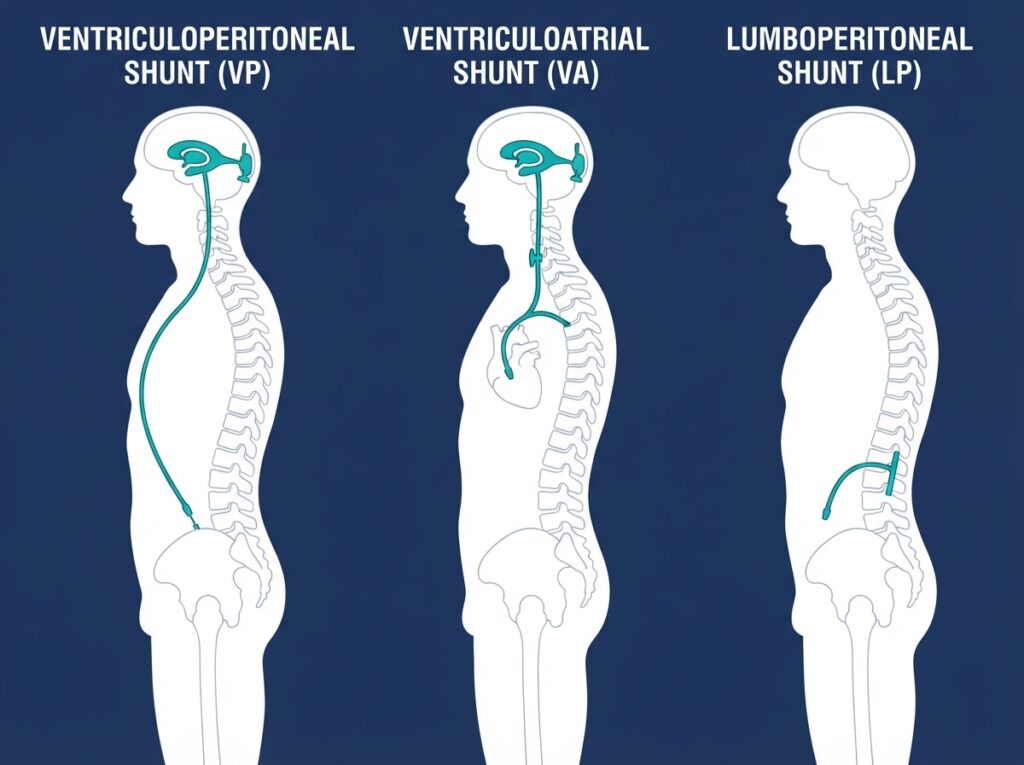
A VP shunt — ventriculoperitoneal shunt — is a system of flexible tubing and a pressure-regulating valve that drains excess cerebrospinal fluid (CSF) from the ventricles of the brain to the peritoneal cavity in the abdomen, where it is reabsorbed by the body.
The shunt has three components. The proximal catheter sits inside the ventricle with small holes at its tip that allow CSF to enter. The valve controls drainage — it sits just under the scalp behind the ear and is usually palpable as a small bump. The distal catheter runs under the skin from the valve, down the neck, and into the abdominal cavity.
When CSF pressure rises above the valve’s set threshold, the valve opens and fluid drains into the abdomen. The body produces CSF continuously, at approximately 500ml per day. The shunt ensures this continuous production does not accumulate to dangerous levels.
Types of VP Shunts: The Key Differences
The critical variation in VP shunts is in the valve — the component that does the actual regulatory work. Valves come in two main categories: fixed-pressure and programmable.
Fixed-Pressure Valves
A fixed-pressure valve opens at a specific, predetermined CSF pressure. These valves are mechanically simple and highly durable. They do not require any external programming after implantation.
Fixed-pressure valves are calibrated to a specific pressure range — typically described as low, medium, or high pressure. The limitation: they cannot be adjusted after implantation without a surgical revision. If a child’s optimal pressure dynamics change — as often happens with growth — surgery is required to change the valve.
Programmable Valves
A programmable valve contains a mechanism that can be changed non-invasively from outside the body using a magnetic tool. The neurosurgeon places a small programmable device over the scalp, calibrates it, and adjusts the pressure setting — no surgery, no anaesthesia.
This flexibility is a significant advantage. As a child grows, or if over-drainage or under-drainage develops, the neurosurgeon can adjust the setting at a clinic appointment. Common programmable valve brands include the Codman Hakim, the Medtronic Strata, and the Aesculap proGAV.
The important caveat: strong magnetic fields — including MRI machines — can reset the valve setting. Before any MRI scan, the shunt setting must be checked and may need to be re-programmed afterward.
Other Shunt Types: VA and LP Shunts
Ventriculoatrial (VA) shunts drain CSF from the ventricle to the right atrium of the heart. They are used when peritoneal drainage is not possible — typically because of extensive abdominal surgery or scarring. They carry a small risk of cardiac complications that VP shunts do not.
Lumboperitoneal (LP) shunts drain CSF from the lumbar spinal fluid space into the peritoneum. They are used for specific types of hydrocephalus, particularly communicating hydrocephalus and pseudotumour cerebri. They are not suitable for obstructive hydrocephalus.
Over-Drainage and Under-Drainage: Why Valve Choice Matters
Over-drainage occurs when the shunt drains too aggressively, reducing CSF pressure below optimal levels. Symptoms include orthostatic headaches — better when lying down, worse when upright. Chronic over-drainage can lead to slit ventricle syndrome. A 2022 study by Tamburrini et al. in Child’s Nervous System identified over-drainage as a cause of shunt-related disability in approximately 8% of long-term paediatric shunt patients. Available at: https://pubmed.ncbi.nlm.nih.gov/35384393/
Under-drainage occurs when the valve pressure is set too high — fluid drains insufficiently, and the child’s pressure remains elevated. Symptoms mirror original hydrocephalus: morning headaches, vomiting, and behavioural change.
What to Ask About Your Child’s Shunt
- “What brand and model is my child’s shunt valve?”
- “Is it fixed-pressure or programmable? If programmable, what is the current setting?”
- “If it is programmable, what happens if my child has an MRI — who is responsible for checking and re-programming the valve afterward?”
- “Do you have a shunt card or implant record I can keep in my child’s medical file?”
A shunt implant card — listing the device make, model, serial number, and current valve setting — should be issued to parents at the time of implantation. If you were not given one, ask for it now.
What the Research Shows

The largest randomised trial in paediatric hydrocephalus, the BASICS trial published in The Lancet in 2019 by Kulkarni et al., compared valve types in 351 children and found that overall shunt survival was not significantly different between valve types when all children were considered together. The study concluded that valve selection should be individualised. Available at: https://pubmed.ncbi.nlm.nih.gov/31679936/

Frequently Asked Questions
What is the difference between a fixed-pressure and programmable shunt valve?
A fixed-pressure valve drains CSF at a predetermined, unchangeable pressure threshold. A programmable valve can be adjusted non-invasively after implantation using a magnetic tool at a clinic appointment. Programmable valves offer more flexibility — if a child’s symptoms suggest over- or under-drainage, the setting can be changed without surgery. The trade-off is that MRI scans can reset programmable valve settings, requiring a protocol check before and after imaging.
Can a VP shunt valve be replaced without replacing the whole shunt?
Yes. In most revision surgeries involving valve malfunction or incorrect pressure setting, only the valve is replaced. The proximal catheter and distal catheter can often be retained if they are intact. This makes isolated valve revision shorter and simpler than complete shunt replacement.
What happens if my child’s shunt setting is wrong?
An incorrect shunt pressure setting causes either over-drainage (headaches worse when upright) or under-drainage (headaches worse when lying down, vomiting). If you notice either pattern, contact your neurosurgical team. For programmable valves, the setting can be adjusted in clinic. For fixed-pressure valves, a revision is required.
How do I know what type of shunt my child has?
Ask your neurosurgical team and request a shunt implant card — a small card with the device brand, model, and settings. If your child has ever had an MRI report or surgical notes, the shunt type will be documented there. This information is essential in any emergency assessment or if your child moves to a new medical team.
I know what type of shunt my son has now. I know the valve brand and the current setting. I have a laminated card in my wallet with the information, the neurosurgeon’s contact number, and the MRI protocol. He does not think much about his shunt. He calls it, when he refers to it at all, “the drain.” Some mornings he puts his small hand behind his ear and pushes gently against the valve housing. I asked him once if it bothered him. He said no, it just felt like part of his head. Which is, I suppose, exactly what it is.
This article is for informational purposes only and does not constitute medical advice. Always consult your neurologist, paediatrician, or qualified healthcare provider. Read our full medical disclaimer at braincarepath.com/disclaimer/
References: Kulkarni et al., Lancet Neurol 2019 (PMID 31679936) · Tamburrini et al., Childs Nerv Syst 2022 (PMID 35384393) · Tuli et al., J Neurosurg Pediatr 2021 (PMID 33951734)
Frequently Asked Questions About Shunt Types
What is a programmable shunt?
A programmable shunt has a valve whose pressure setting can be changed non-invasively from outside the body using a magnetic device. This allows the surgeon to adjust drainage without further surgery, which is useful if a child is over-draining or under-draining.
Do programmable shunts get affected by magnets?
Strong magnets can alter the setting of some programmable valves. Everyday items such as phones and headphones are generally safe at normal distance, but MRI scanners will change the setting, so it must be checked and reset afterwards. Carry your valve card.
Which type of shunt is best?
There is no single best shunt. Research has found that outcomes relate more to the number of revisions a person needs than to which valve type was used. Surgeons choose based on age, cause, anatomy and their own experience with a given system.
What is the difference between a VP and a VA shunt?
A ventriculoperitoneal (VP) shunt drains fluid to the abdomen, which is the most common route. A ventriculoatrial (VA) shunt drains into a vein leading to the heart, and is used when the abdomen is unsuitable, for example after repeated infection or extensive scarring.