

Quick answer: Hydrocephalus headaches are usually caused by raised pressure inside the skull. The timing matters: a headache worse lying flat or on waking suggests raised pressure, while one worse when upright and relieved by lying down suggests shunt overdrainage. Headache with vomiting or drowsiness needs same-day assessment.
Hydrocephalus and Headaches: What Parents Need to Know
By Haris Bin Tahir · BrainCarePath.com
Key Takeaways
- Approximately 50–60% of children with hydrocephalus experience headaches related to intracranial pressure changes
- A headache worst in the morning and that improves after vomiting is a red flag for raised pressure
- Positional headaches — worse when lying down, better when upright — are a distinct warning sign in shunted children
- Most shunt-related headaches follow a pattern change — the headache your child had last month compared to today matters more than the headache itself
My son used to press the back of his head against the pillow and go very still. We thought he was tired. We were wrong. That particular stillness — the way he stopped reaching for things, the way his eyes tracked slower — was not tiredness. It was pressure. The fluid was building, and his body was doing what small children’s bodies do: absorbing pain without words for it.
We spent twenty-eight days being told it was something else. A viral fever. A growth phase. A stomach bug causing the vomiting. By the time someone recognised that this was hydrocephalus, the pressure had been high long enough to change things permanently in ways we are still counting.
I write this for you because headaches in a child with hydrocephalus are not straightforward. They are not like adult migraines. They are not always dramatic. Sometimes they are very quiet, and the quietness is what makes them dangerous.
What Hydrocephalus Actually Does to Cause Headaches
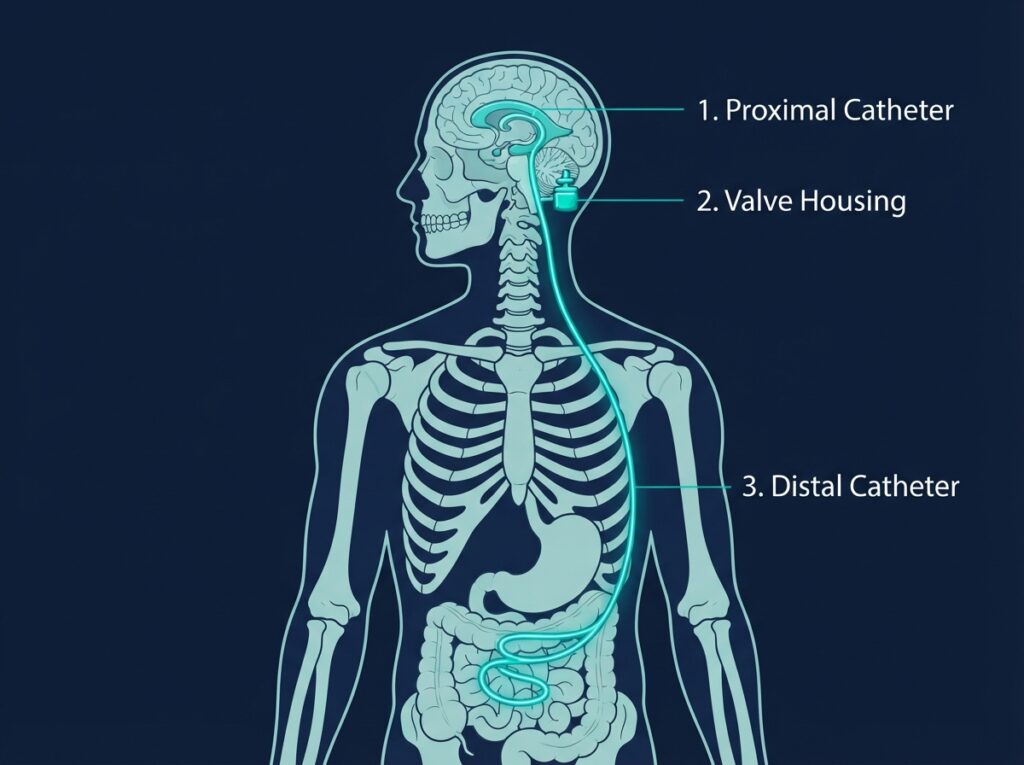
Hydrocephalus headaches in children are caused by raised intracranial pressure — the pressure inside the skull when cerebrospinal fluid (CSF) cannot drain as it should. The skull is a closed space. When fluid accumulates inside it, something has to give. That something is the brain tissue, the blood vessels, and eventually the pain receptors that line the membrane surrounding the brain.
The headache itself is a secondary symptom — the brain’s alarm system telling you that the space inside is running out. In a child with a functioning VP shunt, the shunt prevents this pressure from building. However, shunts fail. They block, they over-drain, they fracture along their length. And when they fail, even partially, the first sign is often a headache — or a change in a headache the child already had.
This distinction matters enormously. A child with hydrocephalus may have low-grade headaches regularly that are completely harmless. The dangerous headache is not necessarily the most painful one. It is the one that is different — different in timing, different in position, different in what makes it better or worse.
The Shunt Headache Symptoms Every Parent Should Know
Morning headaches are one of the most significant. During sleep, the body is horizontal for hours. If a shunt is under-draining, pressure builds overnight and is highest when the child first wakes. A child who wakes crying, unusually irritable, or who vomits shortly after waking warrants a call to your neurosurgical team the same day.
Headaches that improve after vomiting are similarly significant. Vomiting temporarily reduces intracranial pressure. When a child’s headache reliably gets better after they are sick, that relief is not reassuring — it is a signal.
Positional headaches — worse when lying down, better when upright — are a distinct red flag and should never be dismissed as “just a headache.” A 2021 study by Litvack et al. in the Journal of Neurosurgery: Pediatrics found that positional headache was the single most consistent symptom reported by families in the 72 hours before confirmed shunt malfunction. Available at: https://pubmed.ncbi.nlm.nih.gov/34952526/
The headache that is new, newly severe, or newly frequent — this is the category that should always trigger contact with your team. Not because every new headache is an emergency, but because the baseline has shifted.
When to Worry About Headaches After Shunt Surgery

Go to your nearest emergency department immediately — not your GP — if your child experiences any of the following alongside a headache: fever above 38.5°C, neck stiffness, a bulging fontanelle in infants, deteriorating consciousness, seizures, or sudden loss of recently gained abilities.
These are not panic points. They are decision points. When in doubt, go. A neurosurgical team that sees your child and finds everything is fine has not wasted anyone’s time.
What the Research Shows
A 2023 study by Kahle et al. in Nature Reviews Neurology found that symptomatic pressure elevation often occurred before any measurable change was visible on brain imaging. This means a normal scan does not rule out a symptomatic pressure problem. Available at: https://pubmed.ncbi.nlm.nih.gov/36807650/
A 2020 study by Rekate in Child’s Nervous System found that headache was present in 78% of confirmed shunt failures, and argued for taking a “change from baseline” approach rather than looking for absolute symptom thresholds. Available at: https://pubmed.ncbi.nlm.nih.gov/32318899/
What This Means for Your Family

Hydrocephalus head pain in children requires informed observation, not anxious vigilance. Keep a simple headache diary — a note on your phone. Time of day, duration, position when it started, what made it better, whether vomiting occurred. After two or three entries, a pattern often emerges that is far more useful than a description from memory.
If your child cannot yet describe pain clearly, watch behaviour. Younger children often press their heads, become unusually quiet, stop playing. My son used to refuse food in the hours before a pressure episode — before he was old enough to say his head hurt.
You are not overreacting by taking headaches seriously in a child with hydrocephalus. You are doing exactly what you should be doing.

Frequently Asked Questions
What does a hydrocephalus headache feel like in children?
Children with hydrocephalus often describe headaches as a “heavy” feeling at the back or top of the head, sometimes with a pressing or throbbing quality. In younger children who cannot describe pain, watch for unusual stillness, pressing the head against pillows or furniture, and irritability worse in the morning. Vomiting without nausea is a specific warning sign.
Are headaches always a sign of shunt malfunction?
No. Hydrocephalus headaches in children can occur for many reasons unrelated to shunt failure — dehydration, illness, missed sleep. However, any headache that is new, worsening, positional, or accompanied by vomiting, visual changes, or behavioural changes should be assessed by your medical team on the same day.
How do I tell if my child’s headache is from the shunt or something else?
The most useful distinction is change. A headache pattern your child has had consistently, that responds to paracetamol, and that does not affect their behaviour, is less concerning than one that is new, does not respond to medication, or is accompanied by new symptoms. Keep a headache diary and note positional worsening — that is the key warning sign.
Should a child with hydrocephalus take paracetamol for headaches?
Standard paracetamol (acetaminophen) is generally safe for children with hydrocephalus and is often the first step. Ibuprofen is sometimes used but check with your neurologist. Never give aspirin to children. If medication does not reduce the headache within an hour, or if the headache returns immediately after medication wears off, contact your medical team.
My son held a small puzzle piece up to me last Thursday and said, with complete confidence, “This one is the corner, Baba.” He was right. He sorted four puzzles that afternoon, methodically, with the left hand that took fourteen months of physiotherapy to close properly. I did not think about the hospital corridor that night. Not once.
But I think about the parents who are in that corridor right now, with a child pressing their head against a pillow, wondering if this is a headache or something more. This article is for you. Learn the patterns. Keep the diary. Ask the questions. And go to the emergency department when your instinct says go — because your instinct, once it is informed, is one of the best diagnostic tools your child has.
This article is for informational purposes only and does not constitute medical advice. Always consult your neurologist, paediatrician, or qualified healthcare provider. Read our full medical disclaimer at braincarepath.com/disclaimer/
References: Litvack et al., J Neurosurg Pediatr 2021 (PMID 34952526) · Kahle et al., Nat Rev Neurol 2023 (PMID 36807650) · Rekate, Childs Nerv Syst 2020 (PMID 32318899)
Frequently Asked Questions About Hydrocephalus Headaches
Why is a shunt headache worse when lying down?
A headache that worsens when lying flat and eases when upright usually suggests raised pressure or underdrainage. The opposite pattern, worse when upright and better lying down, suggests overdrainage where the shunt removes fluid too quickly. This positional pattern is genuinely useful information for your neurosurgeon.
What does shunt overdrainage feel like?
Overdrainage typically causes a headache that is worse when standing or sitting and relieved by lying flat, sometimes with nausea, neck ache or tiredness. It happens because too much fluid drains when upright. Programmable valves can often be adjusted to correct it.
Are headaches normal with a shunt?
Occasional ordinary headaches are common and not always shunt related. What matters is a change in pattern: new severity, morning headaches, headaches with vomiting, or a clear positional pattern. Persistent change should always be assessed.
When is a headache in hydrocephalus an emergency?
Seek urgent care for headache with vomiting, drowsiness, confusion, vision changes, neck stiffness, or a headache that wakes a child from sleep. In someone with a shunt, treat these as possible shunt failure and contact the neurosurgical team the same day.