

Quick answer: Shunt revision surgery repairs or replaces part of a blocked, infected or outgrown shunt system. Most operations take one to two hours and involve a hospital stay of a few days. Needing a revision is common and expected — it does not mean the first surgery was done badly.
Shunt Revision Surgery: What Parents Should Expect
By Haris Bin Tahir · BrainCarePath.com
🩺 Medically Reviewed by Dr. Zia Mirza — Ex Surgery Registrar | BSc, MBBS (Pb), RMP | Jinnah Hospital, Lahore
Key Takeaways
- Up to 50% of paediatric VP shunts require revision within two years of placement
- Shunt revision surgery is a planned neurosurgical procedure — not a sign that something went catastrophically wrong
- The most common reasons for revision are blockage, infection, and the child’s growth displacing the catheter
- Recovery from revision surgery is typically faster than the initial placement
No one told us the first surgery was probably not the last. They fixed the drain. They placed a VP shunt from my son’s right ventricle down into his abdomen, and we drove home from Rawalpindi with a baby who was finally sleeping without the restless press of his head against anything firm. Fourteen months later, we were back. The shunt had blocked. We needed a revision.
I think the word “revision” sounds manageable — a small correction, a tweak. The reality is that shunt revision surgery is a full return to the operating theatre with your child under general anaesthesia. It is not minor. But it is also not a failure. It is one of the most common neurosurgical procedures performed in children worldwide.
Why VP Shunt Revision Surgery Happens
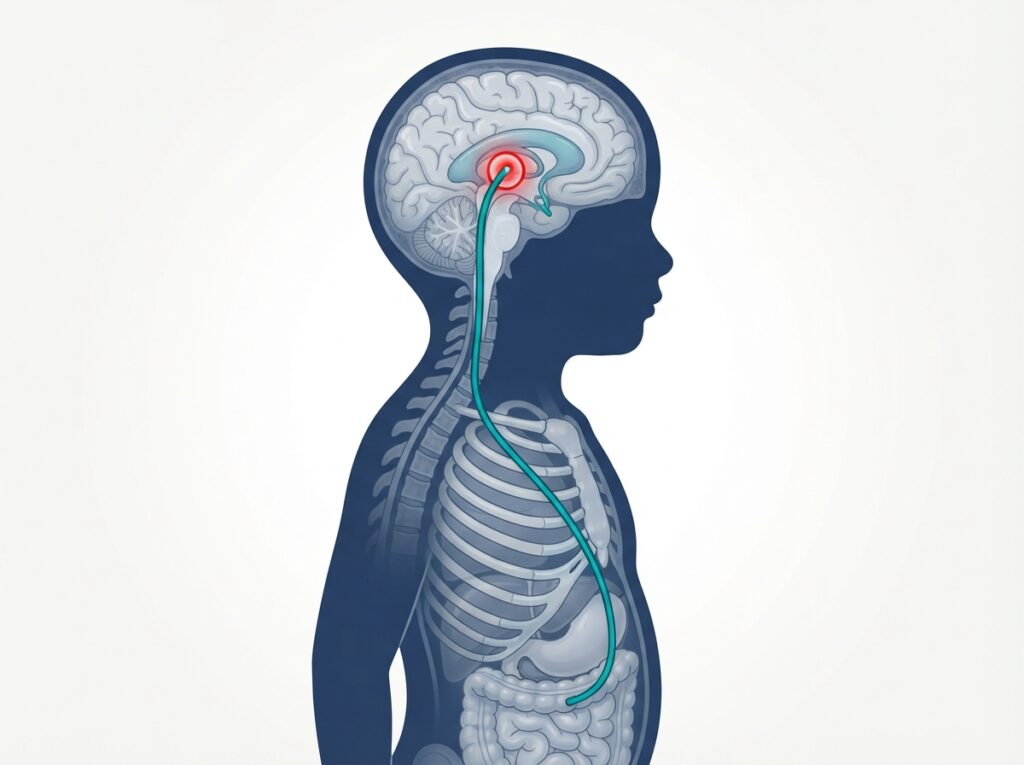
Shunt blockage is the most common cause. The proximal catheter — the tube end inside the ventricle — can become occluded by choroid plexus tissue that grows into its holes. This is not a defect. It is biology. A 2022 review by Dewan et al. in World Neurosurgery found that 40–50% of paediatric shunt revisions occur within the first two years of placement, with proximal blockage being the leading cause. Available at: https://pubmed.ncbi.nlm.nih.gov/35219867/
Shunt infection is a less common but more serious reason for revision. When infection occurs, the standard of care is typically complete shunt removal, antibiotic treatment, and reimplantation.
Distal failure means the abdominal end of the shunt has become blocked or migrated to a position where absorption is poor.
Growth-related displacement is perhaps the most predictable cause. Children grow. The shunt tubing, once positioned correctly, can be pulled upward by growth until it is no longer in the correct position. This typically happens between ages four and seven, when growth is fastest.
How Common Is Shunt Revision in Children?
Shunt revision surgery is very common. A landmark study by Tuli et al. in Pediatric Neurosurgery followed 839 children over ten years and found that the probability of surviving without a shunt revision fell below 50% by five years. Available at: https://pubmed.ncbi.nlm.nih.gov/10859513/
Knowing this changed how I approached the revision when it came. Not with resignation, but with expectation. We were not unlucky. We were part of the predictable reality of a mechanical device placed inside a growing child’s body.
What Shunt Revision Surgery Actually Involves

The procedure for shunt revision surgery in children is neurosurgery. It involves general anaesthesia, a surgical opening at the site of the failed component, removal and replacement of the affected part, and closure. The typical duration in the operating theatre is one to three hours.
Most revisions are simpler than the initial placement. The surgical route is established. Unless infection requires complete removal and reimplantation, the existing hardware can be partially retained. In our case, only the proximal catheter needed replacement — the neurosurgeon made a small incision at my son’s scalp and replaced the blocked tube. He was in theatre for under two hours.
Recovery from shunt revision surgery is typically faster than the initial placement. Most children are monitored in hospital for one to three days after a straightforward revision. Activity is restricted for two to four weeks.
Preparing Your Child for Return to Theatre
Older children — those over three or four years — may have memory of the previous experience. In hospitals with paediatric neurosurgery units, child life specialists are available to help prepare children through age-appropriate explanation and pre-procedural visits to the operating environment. Ask your team whether this is available.
Follow fasting instructions precisely. Children are typically asked to fast from solid food for six hours before surgery and from clear fluids for two hours. A child who is not fasted correctly cannot go to theatre safely — a delay costs everyone an anxious extra wait.
After Surgery: What Indicates Success

The most significant early indicator that the revision has worked is improvement in headache. In most cases of proximal blockage, improvement is apparent within hours of surgery. A child who wakes from revision surgery with a significantly reduced or absent headache has almost certainly had the problem resolved.
A headache that does not improve — or that improves and then returns within twenty-four hours — warrants immediate reassessment. The scalp wound should be inspected daily after discharge. Signs of infection — redness extending beyond wound margins, warmth, discharge, or fever — should be reported to your team the same day.
What the Research Shows About Outcomes
A 2019 study by Garton et al. in Journal of Neurosurgery: Pediatrics found that the number of revisions was not independently predictive of cognitive outcomes when the duration of elevated intracranial pressure before each revision was controlled. Outcomes are better when revisions happen early, before sustained pressure damage occurs. Available at: https://pubmed.ncbi.nlm.nih.gov/31553684/
Questions to Ask Your Surgeon Before Revision
- “Which component needs to be revised — proximal, distal, or valve — and why?”
- “Will the rest of the shunt system be retained or will the entire system be replaced?”
- “Is there any sign of infection? If so, what is the protocol?”
- “What would a successful revision look like — what should improve, and when?”
- “How many revisions of this type do you and your team perform per year?”

Frequently Asked Questions
How common is shunt revision surgery in children?
Very common — studies show 40–85% of paediatric VP shunts require at least one revision within the child’s lifetime, with the highest revision rates in the first two years after placement. This is not a failure of the original surgery; it reflects the biological and mechanical realities of a device placed in a growing child’s body.
How long does shunt revision surgery take?
Most straightforward shunt revisions take one to three hours in theatre. Complete shunt removal and reimplantation due to infection takes significantly longer and involves an inpatient stay of two to four weeks.
What is recovery like after shunt revision surgery?
Recovery from uncomplicated shunt revision is typically faster than the initial placement — most children spend one to three days in hospital and resume normal activity within two to four weeks. The scalp wound needs careful monitoring for infection. Improvement in headache is usually apparent within hours of surgery if the revision resolved the blockage.
How do I know if my child’s shunt revision has worked?
The clearest early sign of a successful revision is improvement in the symptoms that prompted it — typically headache, vomiting, or behavioural changes. If symptoms do not improve within 24–48 hours, contact your team for reassessment.
When they wheeled my son into theatre for the revision, I stood in the corridor afterwards and did not know what to do with my hands. He came back from theatre with a headache he described, for the first time in his life, as “better.” Not the headache he had that morning — the new quietness inside his head. He ate a biscuit at six in the evening and fell asleep before I finished the sentence I was saying to my wife.
It worked. And if you are reading this before your child’s revision, know that it usually does.
This article is for informational purposes only and does not constitute medical advice. Always consult your neurologist, paediatrician, or qualified healthcare provider. Read our full medical disclaimer at braincarepath.com/disclaimer/
References: Dewan et al., World Neurosurg 2022 (PMID 35219867) · Tuli et al., J Neurosurg 2000 (PMID 10859513) · Garton et al., J Neurosurg Pediatr 2019 (PMID 31553684)
How many times can a shunt be revised?
There is no fixed limit. Some people have one revision in a lifetime; others have several. Surgeons weigh each revision individually rather than working to a maximum number. Research does show that a higher number of revisions is associated with poorer motor outcomes and quality of life.
Is shunt revision surgery dangerous?
It is a common neurosurgical procedure with a well-established safety record, though every operation carries risk — chiefly infection, bleeding, and the possibility that the revision itself fails. The risk of leaving a blocked shunt untreated is generally far greater than the risk of surgery.
Why does a shunt need revising more than once?
Shunts are mechanical devices inside a growing body. Tubing can become too short as a child grows, catheters can block with tissue or debris, valves can fail, and infection can force removal. None of these mean anything was done wrong at the first operation.