
By Haris Bin Tahir | 16 November 2026 | Epilepsy & Seizures
Father of a hydrocephalus survivor. Independent researcher.
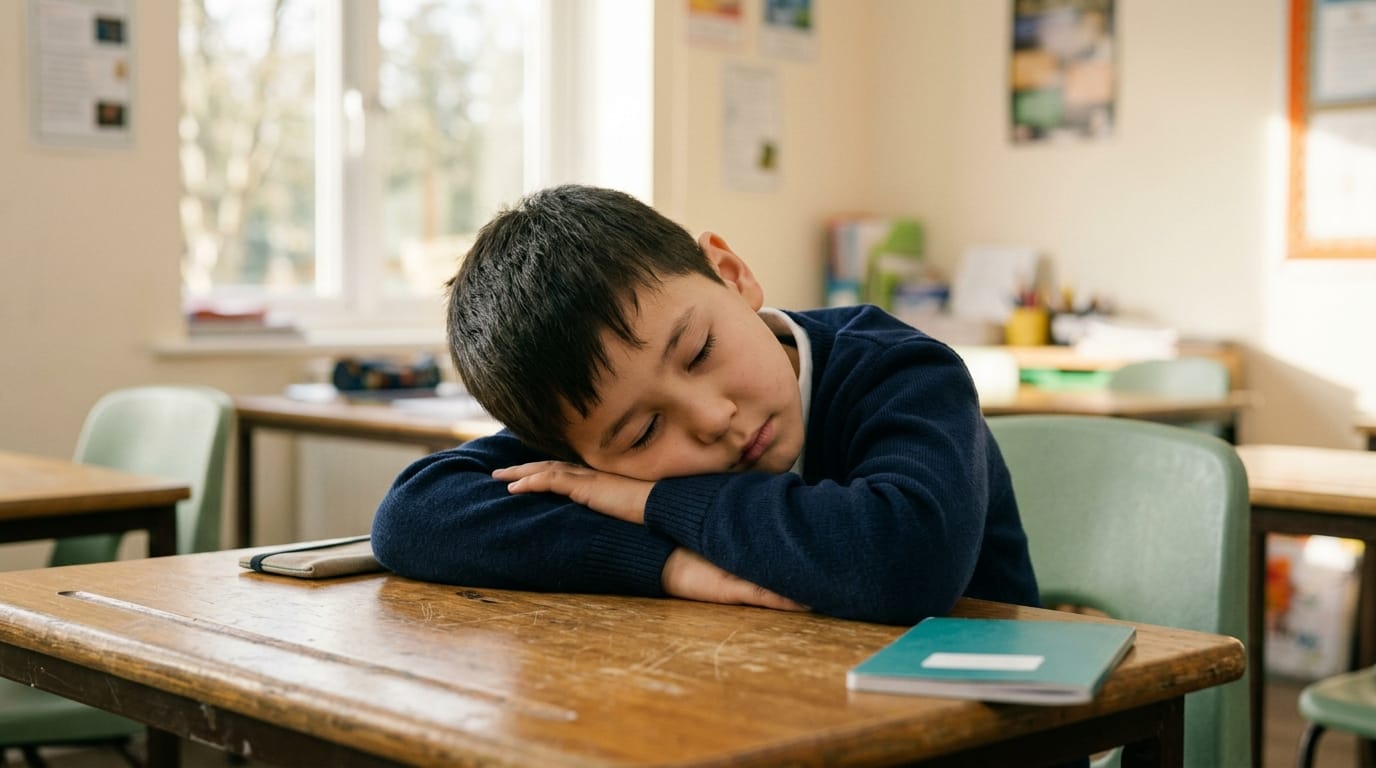
Quick answer: An absence seizure in children is a brief lapse of awareness, usually 10 to 20 seconds, that starts and stops abruptly and is often mistaken for daydreaming. Stay beside your child, time the episode, and do not shake them. Most need no first aid. However, a first episode always needs a doctor.
Her teacher wrote it on the end-of-term report in a kind, careless sentence: drifts off sometimes, could try harder to focus. Nobody thought much of it. Then one morning at the kitchen table her mother watched it happen from two feet away — the crayon stopped moving, the eyes went somewhere else, and for perhaps twelve seconds the girl simply was not there. Then she carried on colouring, mid-stroke, as though nothing had interrupted her. She did not know anything had.
That gap is what an absence seizure in children actually looks like. Not a convulsion. Not a fall. A pause. And because it looks so ordinary, it is one of the most frequently missed seizure types in childhood — often mistaken for inattention, hearing trouble, or a child who daydreams. Here is what I understand after two and a half years in neurology waiting rooms, and what the research says. Some of it I am still not certain about, and I will say so where that is true.

What Does an Absence Seizure in Children Look Like?
It looks like absence, which is why it carries that name. Moreover, the episode begins without warning and ends just as sharply. There is no aura beforehand, and afterwards there is no confusion or sleepiness — the child resumes the sentence, the step, or the mouthful they were halfway through.
Typical features include:
- a blank stare and loss of awareness, usually lasting under 20 seconds
- abrupt start and abrupt finish, with no drowsy recovery period
- fluttering eyelids, slight lip movements, or small hand automatisms in some children
- no memory of the episode at all
- episodes that can repeat many times in a single day
In a 2021 study of 35 children with childhood absence epilepsy at King Saud University Medical City, every single patient presented with staring and altered awareness, and 94.2% were having fewer than 20 episodes a day when they were diagnosed (Bashiri et al., International Journal of Pediatrics & Adolescent Medicine, 2021). In addition, around a fifth showed eye fluttering alongside the electrical seizure activity.
What Should You Do During an Absence Seizure?
Far less than instinct demands, and that is genuinely hard. So the urge is to shake a child back into the room. Yet resist it — it does not shorten the seizure and it frightens a child who does not know they left.
During the episode:
- Stay beside them and keep them safe from stairs, roads, water or hot surfaces.
- Look at a clock and time it. Duration is the single most useful thing you can tell a doctor.
- Do not shake, shout or splash water. None of it helps.
- Note what you saw — eyelids, hands, lips, whether they fell.
- Repeat what they missed calmly when they return, without making a performance of it.
Most absence seizures need no first aid because the child does not fall or stop breathing. Convulsive seizures are a different situation entirely, and our step-by-step seizure first aid guide for parents covers that sequence properly.
Call emergency services if any episode lasts longer than five minutes, if it becomes convulsive, if breathing becomes difficult, if the child is injured, or if episodes come one after another without full recovery between them. Additionally, a first-ever seizure of any kind should be assessed the same day, even when the child seems entirely well afterwards.

Why Do Absence Seizures in Children Get Missed So Often?
Because the symptom is an absence of something rather than the presence of something. For example, a convulsion announces itself. A twelve-second gap does not.
Three things conspire. First, the episodes are brief enough to be read as ordinary inattention. Second, they cluster in school hours, where a distracted child is an unremarkable child. Third, they most commonly begin between the ages of four and ten — precisely the years when adults expect daydreaming anyway. In that same 2021 cohort, the average age at diagnosis was seven.
So a child may be labelled inattentive long before anyone considers epilepsy. Our guide to living with epilepsy and managing seizures day to day makes the same point: childhood epilepsy frequently does not look like the convulsions most people picture.
How Do Doctors Confirm an Absence Seizure?
With an EEG, which records the brain’s electrical activity through scalp sensors. It does not hurt, and it is also the test that settles the question.
Specifically, absence seizures produce a distinctive signature: bilateral, symmetrical, synchronous 3 Hz spike-and-wave discharges. Furthermore, all 35 children in the Bashiri study showed that pattern. Clinicians also often ask the child to breathe deeply and rapidly for a couple of minutes during the recording, because hyperventilation reliably provokes absence seizures — it brought one on in 65.7% of that cohort, which is why it is done in a monitored clinic and not attempted at home.
Our article on epilepsy diagnosis in children: tests and criteria walks through what the appointment itself involves. The National Institute of Neurological Disorders and Stroke also publishes a plain-language overview of seizure types worth reading before you go.

What the Research Shows
Here is the part that surprised me, and it is genuinely good news.
A retrospective analysis of 29 published studies covering 2,416 patients found that the proportion of children achieving seizure-freedom off medication rose from 35% in studies published before 1975 to 82% in studies published after 1985 (Morse et al., Epilepsy Research, 2019). The researchers linked much of that improvement to the wider use of ethosuximide and valproate: children treated with one of those medicines were seizure-free off medication 64% of the time, against 32% for those given other drugs.
Similarly, in the 2021 Saudi cohort, 94.3% of children had their seizures clinically controlled, 80% had a normal EEG within a few months of starting treatment, and 37.2% were in complete remission after three to five years. One child later developed juvenile myoclonic epilepsy, which is a reminder that absence epilepsy does not always end neatly.
More broadly, a Cochrane network meta-analysis of antiepileptic monotherapy — 14,789 participants across 39 trials — notes that roughly 60% to 70% of people with epilepsy achieve longer-term remission, most of them soon after starting treatment (Nevitt et al., Cochrane Database of Systematic Reviews, 2022).
Two honest caveats. The 2021 study followed 35 children at a single centre, so its percentages should be read as encouraging rather than definitive. And the Morse analysis was retrospective, comparing studies conducted decades apart under different diagnostic criteria — later studies were more likely to require a normal EEG background, which may itself select for children who do better.
What This Means for Your Family
Therefore, four things follow in practice.
- Write it down. Dates, times, durations, what you saw. A two-week log is worth more at the appointment than any description from memory.
- Tell the school, in writing. Teachers see most of these episodes. They cannot report what they have not been asked to watch for.
- Treat water and roads differently. A twelve-second gap matters far more in a swimming pool than at a kitchen table.
- Watch the tiredness. Sleep affects seizure thresholds, and our summary of what the research shows about sleep and brain recovery in children is worth reading alongside this.
If your child has just been diagnosed, this section matters most: the prognosis for childhood absence epilepsy is, on the whole, among the more hopeful in paediatric neurology. However, that is not a promise about your child. Yet it is a reason not to read the worst into a diagnosis that frequently resolves.
Questions to Ask Your Doctor
- Does the EEG pattern fit childhood absence epilepsy specifically, or another syndrome?
- How many episodes a day do you think my child is actually having?
- Which medication are you recommending, and why that one first?
- What side effects should make me call you rather than wait?
- What activities need supervision now — swimming, cycling, baths?
- How will we know whether treatment is working, and when would you repeat the EEG?
- If seizures stop, how long before you would consider withdrawing medication?
- What should the school be told, and will you put it in writing?
Frequently Asked Questions About Absence Seizures in Children
What should you do if a child has an absence seizure?
Stay beside them, move anything hazardous away, and time the episode by a clock. Do not shake or shout at them, because it does not help. When awareness returns, calmly repeat whatever they missed. A first-ever episode should be assessed by a doctor the same day.
What do absence seizures in children look like?
They look like a brief blank stare, usually under 20 seconds, starting and stopping abruptly with no warning and no drowsiness afterwards. Some children flutter their eyelids or make small lip or hand movements. The child has no memory of it and resumes exactly what they were doing.
Do children grow out of absence seizures?
Many do. One 2021 cohort reported complete remission in 37.2% of children after three to five years, and a larger review found 82% seizure-free off medication in studies published after 1985. Outcomes vary by child, and our guide on whether children outgrow epilepsy covers this in depth.
Can absence seizures happen while a child is sleeping?
Absence seizures themselves occur during wakefulness, since they involve a visible lapse in awareness. However, the underlying spike-and-wave discharges can still appear on an EEG recorded during sleep. Night-time events that look different may be another seizure type and are worth describing to your neurologist.
Are absence seizures dangerous?
The episode itself is brief and does not usually cause injury. The risk lies in when it happens — in water, on a bicycle, crossing a road, or near a hot surface. Frequent untreated episodes can also interrupt learning, which is why diagnosis and supervision matter.
The crayon is the detail I keep returning to. It stopped, and then it carried on, and the gap between those two things was the whole diagnosis — sitting there in plain sight at a kitchen table, for months, written off as daydreaming by everyone who loved her.
So if you have watched something like that and talked yourself out of it, go and get the EEG. You are not overreacting. You are doing the one thing a report card cannot do, which is to take twelve seconds seriously.
This article is written for informational purposes only and does not constitute medical advice. Always consult your neurologist, paediatrician, or qualified healthcare provider for diagnosis and treatment decisions specific to your child’s situation. Read our full medical disclaimer at braincarepath.com/disclaimer/
References
- Bashiri FA, Al Dosari A, Hamad MH, Kentab AY, Alwadei AH. Childhood absence epilepsy: Electro-clinical manifestations, treatment options, and outcome in a tertiary educational center. Int J Pediatr Adolesc Med. 2021;9(2):131-135. Available at: https://pubmed.ncbi.nlm.nih.gov/35663781/ · doi: 10.1016/j.ijpam.2021.11.003
- Morse E, Giblin K, Chung MH, Dohle C, Berg AT, Blumenfeld H. Historical trend toward improved long-term outcome in childhood absence epilepsy. Epilepsy Res. 2019;152:7-10. Available at: https://pubmed.ncbi.nlm.nih.gov/30856420/ · doi: 10.1016/j.eplepsyres.2019.02.013
- Nevitt SJ, Sudell M, Cividini S, Marson AG, Tudur Smith C. Antiepileptic drug monotherapy for epilepsy: a network meta-analysis of individual participant data. Cochrane Database Syst Rev. 2022;4(4):CD011412. Available at: https://pubmed.ncbi.nlm.nih.gov/35363878/ · doi: 10.1002/14651858.CD011412.pub4
- National Institute of Neurological Disorders and Stroke. Epilepsy and Seizures. Available at: https://www.ninds.nih.gov/health-information/disorders/epilepsy-and-seizures