
Quick answer: Epilepsy in children is diagnosed when a child has two or more unprovoked seizures more than 24 hours apart, or one seizure with a high risk of more. Diagnosis rests on a detailed description of the events, supported by EEG and MRI. A normal EEG does not rule epilepsy out.
Epilepsy Diagnosis in Children: A Guide for Worried Parents
By Haris Bin Tahir · BrainCarePath.com
🔬 Medically Reviewed by Dr. Maryam Tahir — Consultant Neurologist | FCPS (Neurology) | MRCP (UK) | Assistant Professor, Faisalabad Medical University
Key Takeaways
- Epilepsy is diagnosed after two or more unprovoked seizures — a single seizure does not automatically mean a diagnosis
- The EEG is a key diagnostic tool but a normal EEG does not rule out epilepsy — many children with confirmed epilepsy have normal EEGs between seizures
- Childhood epilepsy syndromes vary widely in severity and prognosis — some resolve completely by adolescence
- Early and accurate diagnosis is the most important predictor of treatment success
The neurologist said “epilepsy” and I did not hear the next four sentences. I know because I later asked my wife what was said, and she had not heard them either. We were both sitting forward in our chairs, and neither of us was listening — we were just absorbing that one word and its weight.
This is the experience of epilepsy diagnosis in children as most families actually live it. You hear the word. You stop hearing other words. You drive home and spend three days reading the internet at two in the morning, and half of what you read terrifies you, and the other half gives you hope, and you cannot tell which half is true.
What Is an Epilepsy Diagnosis, Exactly?
Epilepsy diagnosis in children requires, by the standard definitions used by the International League Against Epilepsy (ILAE), one of the following: two or more unprovoked seizures occurring more than twenty-four hours apart, or one unprovoked seizure with a high probability of further seizures based on brain imaging or EEG findings.
A single seizure, by itself, does not automatically mean an epilepsy diagnosis. Many children have a single febrile seizure — triggered by high fever — that never recurs and does not represent epilepsy. After a first unprovoked seizure, the risk of recurrence is approximately 40–50%. After a second, it rises to 70–80%.
How Is Childhood Epilepsy Diagnosed?
The diagnosis of childhood epilepsy is clinical — meaning it depends primarily on the neurologist’s judgement, not on any single test. Tests support the diagnosis and help classify the type.
Clinical history is the most important part. Your neurologist will ask detailed questions about what the seizure looked like — which part of the body was involved, how it started, how long it lasted, what happened afterward. Video footage of a seizure, if you have it, is extremely valuable. Many families now record seizures on a phone specifically to share with their medical team.
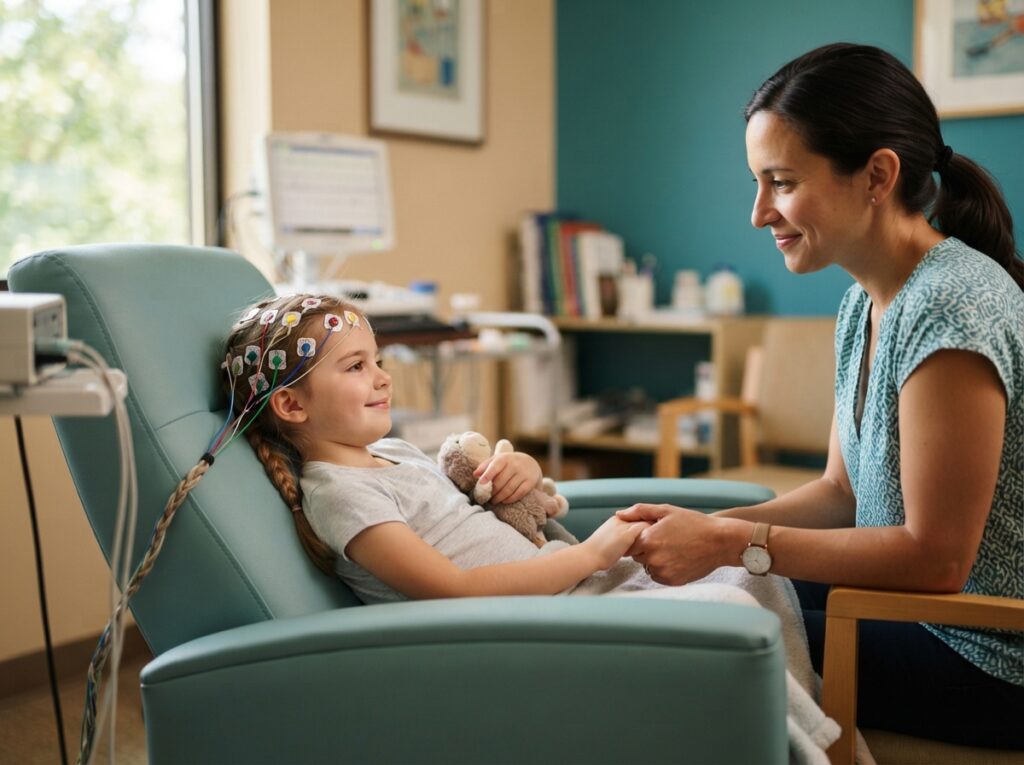
EEG (electroencephalogram) records the electrical activity of the brain via electrodes placed on the scalp. However: a normal EEG does not rule out epilepsy. A 2019 review by Shellhaas et al. in Pediatric Neurology found that up to 50% of children with confirmed epilepsy have normal EEGs in the interictal period. Available at: https://pubmed.ncbi.nlm.nih.gov/30898393/
Brain MRI is recommended for most children newly diagnosed with epilepsy to look for structural causes — lesions, cortical malformations, tumours, or scarring. A normal MRI does not exclude a structural cause, but it substantially reduces the probability.
Childhood Epilepsy Types: Why Classification Matters

Childhood absence epilepsy (CAE) presents between ages four and eight with brief staring spells — the child goes blank for five to twenty seconds, then resumes without confusion. It responds well to specific medications, and approximately 60–70% of children achieve remission by adolescence.
Rolandic epilepsy is a common and generally benign syndrome beginning between ages five and ten, typically with tingling or jerking of one side of the face. Most children outgrow it by age sixteen.
Dravet syndrome is at the more severe end — a genetic epilepsy with prolonged febrile seizures beginning in the first year of life, followed by multiple seizure types and developmental challenges. Treatment is complex and managed by a specialist epilepsy centre.
Lennox-Gastaut syndrome is another severe syndrome with multiple seizure types, typically beginning in the toddler years. It is associated with significant cognitive and behavioural challenges.
Do not be afraid to ask your neurologist for the specific diagnosis name — not just “epilepsy,” but the syndrome.
What Happens After a First Seizure?
For any child with no prior neurological conditions and a single brief focal seizure, the paediatrician may take a watchful approach without medication and refer to a paediatric neurologist for outpatient assessment.
For any child who has a seizure lasting more than five minutes, or who has two or more seizures in a single day without full recovery between them, this is status epilepticus — a neurological emergency. Call emergency services. Do not drive to the hospital yourself.
When first seizures are investigated, parents are often given instructions on what to do if another occurs. Write these down. The guidance for generalised tonic-clonic seizures is: do not restrain the child, remove objects from around them, time the seizure from the start, turn them gently onto their side after convulsions stop, and call emergency services if the seizure lasts more than five minutes.
What the Research Shows About Treatment Outcomes

A 2020 population-based study by Berg et al. in Neurology followed children with new-onset epilepsy for twenty years and found that 65% achieved sustained seizure remission, with many achieving this within the first two to five years of diagnosis. Available at: https://pubmed.ncbi.nlm.nih.gov/32349019/
Anti-seizure medications are effective in achieving seizure control in approximately 70% of children with epilepsy. The choice of medication depends on the seizure type and syndrome — prescribing the wrong medication for a syndrome can worsen seizure frequency. This is why accurate syndrome classification matters.
What This Means for Your Family
Tell the school. Tell the swimming teacher. Tell the grandparents. The people around your child cannot protect them if they do not know what to watch for and what to do. Schools are legally required to accommodate children with epilepsy in most countries. An epilepsy action plan — prepared with your medical team — is essential documentation for the school.
Swimming should always be supervised. Showering is generally safer than bathing unsupervised. Cycling with a helmet is generally considered acceptable — discuss specifics with your neurologist.

Frequently Asked Questions
What tests are used to diagnose epilepsy in children?
The main tests are the EEG (electroencephalogram) and brain MRI. A normal result on either test does not rule out epilepsy — diagnosis is clinical and based on the doctor’s assessment of the full picture, including a detailed description of the seizures.
Can a child have epilepsy with a normal EEG?
Yes. Up to half of children with confirmed epilepsy have normal EEGs between seizures. A normal EEG does not mean seizures are not happening. Neurologists rely on the full clinical history alongside test results when making the diagnosis.
What happens after an epilepsy diagnosis — will my child need medication immediately?
Not always. After a first unprovoked seizure, many neurologists take a watchful approach without immediate medication. After a confirmed diagnosis (two or more unprovoked seizures), anti-seizure medication is typically recommended. The specific drug depends on your child’s seizure type and syndrome.
Can children grow out of epilepsy?
Many childhood epilepsy syndromes do resolve. Childhood absence epilepsy achieves remission in 60–70% of cases by adolescence. Rolandic epilepsy almost always resolves by age sixteen. However, other syndromes — particularly those with a structural or genetic basis — are lifelong. Your neurologist’s assessment of your child’s specific syndrome will give you the most accurate prognosis.
Three weeks after the word “epilepsy” was said in that consultation room, I found myself on the phone to a pharmacy at seven in the morning because we had run out of levetiracetam. In that moment, I realised: the fear I had felt when the word was first spoken had transformed into something more manageable. Not absence of fear. Competence alongside fear. I knew what the medication was for. I knew what to watch for. I knew what to do if a seizure came.
That knowledge does not remove the weight. But it changes your relationship to it. You are no longer a passenger. You are someone who knows where the controls are.
This article is for informational purposes only and does not constitute medical advice. Always consult your neurologist, paediatrician, or qualified healthcare provider. Read our full medical disclaimer at braincarepath.com/disclaimer/
References: Shellhaas et al., Pediatr Neurol 2019 (PMID 30898393) · Berg et al., Neurology 2020 (PMID 32349019) · ILAE Commission, Epilepsia 2014 (PMID 24730690)
What are the diagnostic criteria for epilepsy?
The International League Against Epilepsy defines epilepsy as either two unprovoked seizures more than 24 hours apart, or one unprovoked seizure with a high likelihood of further seizures, or diagnosis of an epilepsy syndrome. A single provoked seizure — from fever or low blood sugar, for example — does not meet the criteria.
How long does it take to diagnose epilepsy in a child?
It can take weeks to months. Diagnosis depends heavily on eyewitness description, and tests may need repeating. Because a normal EEG does not rule epilepsy out, doctors often wait to see whether further seizures occur before confirming. Video recordings of events genuinely speed this up.
What are the main types of childhood epilepsy?
Common childhood types include childhood absence epilepsy, juvenile myoclonic epilepsy, benign rolandic epilepsy, focal epilepsies, and more severe syndromes such as Lennox-Gastaut and Dravet. Classification matters because it guides which medication is chosen and what outlook to expect.