
Quick answer: Choosing daycare or preschool for a child with hydrocephalus or epilepsy comes down to three things: whether staff can be trained on your child’s specific seizure or shunt symptoms, whether a written seizure action plan and medication authorization can be properly implemented, and how the facility handles communication during and after an incident. Most licensed centers can accommodate this with the right preparation, even without prior experience.
Touring daycares while quietly rehearsing how to explain “shunt malfunction symptoms” to someone who has never heard the term is its own particular kind of exhausting. I toured four centers before finding a director willing to sit down for a real conversation rather than a polite, rushed one. That conversation is worth insisting on before enrollment, not after.
Start With a Direct Conversation, Not a Tour Alone
A facility’s physical space matters far less than its willingness to genuinely engage with your child’s specific medical needs. Ask directly, early in the process: has this center cared for a child with a seizure disorder or a shunt before, and if not, are they open to training? A center’s honest “we haven’t, but we’re willing to learn properly” is often a better sign than a vague “we’re sure it’ll be fine” from a facility that has not really thought it through.

The Seizure Action Plan Is Non-Negotiable
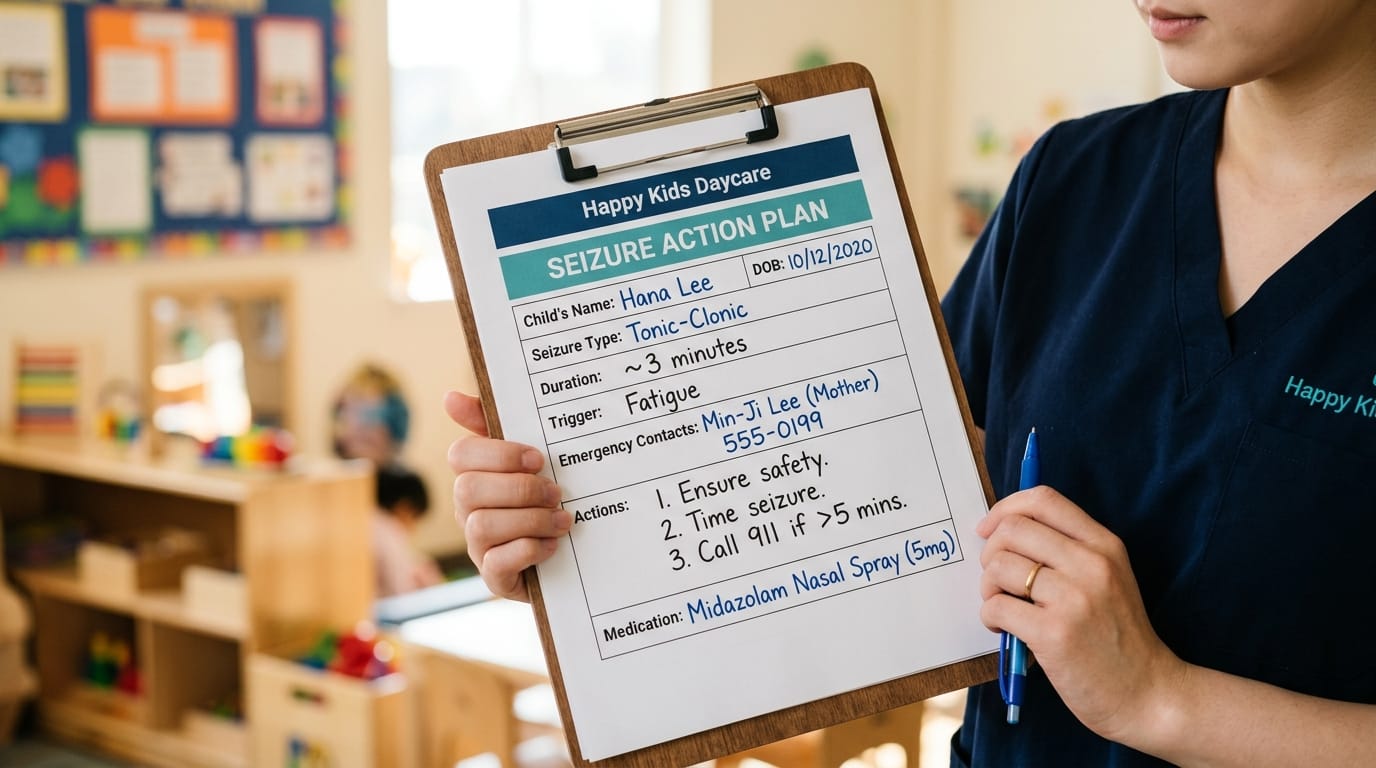
If your child has epilepsy, a written seizure action plan — created with your neurologist — should specify exactly what a typical seizure looks like for your child, how long is normal versus when to call emergency services, any rescue medication and precise administration instructions, and who to contact and in what order. This document should be reviewed with every staff member who will supervise your child, not left in a file cabinet. Many states require licensed daycare staff to complete specific medication administration training before they can legally give rescue medications like rectal or intranasal diazepam, so ask this question directly and early, since it can affect enrollment timelines.
What Staff Actually Need to Know About a Shunt
For a child with a shunt, staff do not need to understand the surgery itself, but they do need a clear, written list of specific warning signs — headache, vomiting, unusual sleepiness, irritability — and exactly what to do if those appear: call you immediately, and call emergency services if symptoms are severe or your child becomes difficult to wake. It is also worth specifically discussing playground and physical activity precautions relevant to your child’s age and shunt history, since these vary considerably from one shunt situation to another.

Using Early Intervention and IEP/504 Processes Early
Children under three with a hydrocephalus or epilepsy diagnosis are frequently eligible for early intervention services, which can include developmental therapies delivered at daycare itself in some states. For preschool-age children, an Individualized Education Program (IEP) or a 504 plan can formalize necessary accommodations, including staff training requirements and emergency protocols, giving families a documented, enforceable framework rather than relying solely on informal goodwill from a given center or director.
Red Flags Worth Taking Seriously
A facility that seems reluctant to have a real conversation about your child’s needs, that cannot describe its own staff medication training process clearly, or that pushes back on a written seizure action plan being kept on-site and reviewed with staff, is worth reconsidering — even if the facility is otherwise appealing. These are reasonable, standard requests, not unusual demands, and a center’s response to them tells you a great deal about how it will actually handle a real incident.

What This Means for Your Family
The right daycare or preschool for your child is not necessarily the one with the most prior experience with hydrocephalus or epilepsy specifically — it is the one willing to be trained thoroughly and to treat your written plans as operational documents rather than paperwork. That willingness, more than prior experience alone, is the strongest predictor of how a real incident will actually be handled.
Questions to Ask a Daycare or Preschool
- Has staff cared for a child with a seizure disorder or shunt before, and are they open to specific training if not?
- Who administers medication, and what state-required training do they need to complete first?
- How is a seizure action plan or shunt warning-sign sheet kept accessible and reviewed with staff?
- What is the facility’s specific protocol for contacting parents versus calling emergency services?
- Can accommodations be formalized through an early intervention plan, IEP, or 504 plan?

Frequently Asked Questions About Daycare for Kids With Hydrocephalus or Epilepsy
Do all daycare staff need seizure training?
At minimum, every staff member supervising your child should understand your child’s specific seizure action plan. Formal rescue medication administration typically requires state-mandated training for whichever specific staff member will be authorized to give it.
Can a daycare legally refuse to enroll a child with epilepsy or hydrocephalus?
Generally no. Licensed childcare centers are typically covered under disability discrimination laws requiring reasonable accommodation, though the specifics vary by location and facility type.
What is a seizure action plan?
A written document, created with your neurologist, describing what your child’s seizures typically look like, when to call emergency services, rescue medication instructions if applicable, and emergency contacts.
Should I disclose my child’s diagnosis before enrollment?
Yes. Disclosing early allows the facility genuine time to prepare, train staff appropriately, and have an honest conversation about whether they can meet your child’s specific needs before your child is already enrolled.
That fourth director, the one willing to have the real conversation, ended up training her whole staff before our son’s first day. It is possible to find that. It sometimes just takes touring one more center than feels reasonable.
This article is written for informational purposes only and does not constitute medical or legal advice. Always consult your neurologist, paediatrician, or qualified healthcare provider, and your state’s specific childcare licensing regulations, for guidance specific to your situation. Read our full medical disclaimer at braincarepath.com/disclaimer/
Bibliography
- Epilepsy Foundation. Seizure Action Plans for Schools and Childcare. Available at: https://www.epilepsy.com/
- Hydrocephalus Association. School and Childcare Considerations. Available at: https://www.hydroassoc.org/
- U.S. Department of Education. Early Intervention Program for Infants and Toddlers with Disabilities (IDEA Part C). Available at: https://sites.ed.gov/idea/