

Quick answer: Parents of a newborn admitted to the NICU, or diagnosed with a serious condition like hydrocephalus shortly after birth, face a meaningfully elevated risk of postpartum depression, anxiety, and post-traumatic stress disorder — separate from, and often less discussed than, the medical care their baby receives. This is a well-documented, common response, not a sign of failing to cope, and effective support exists.
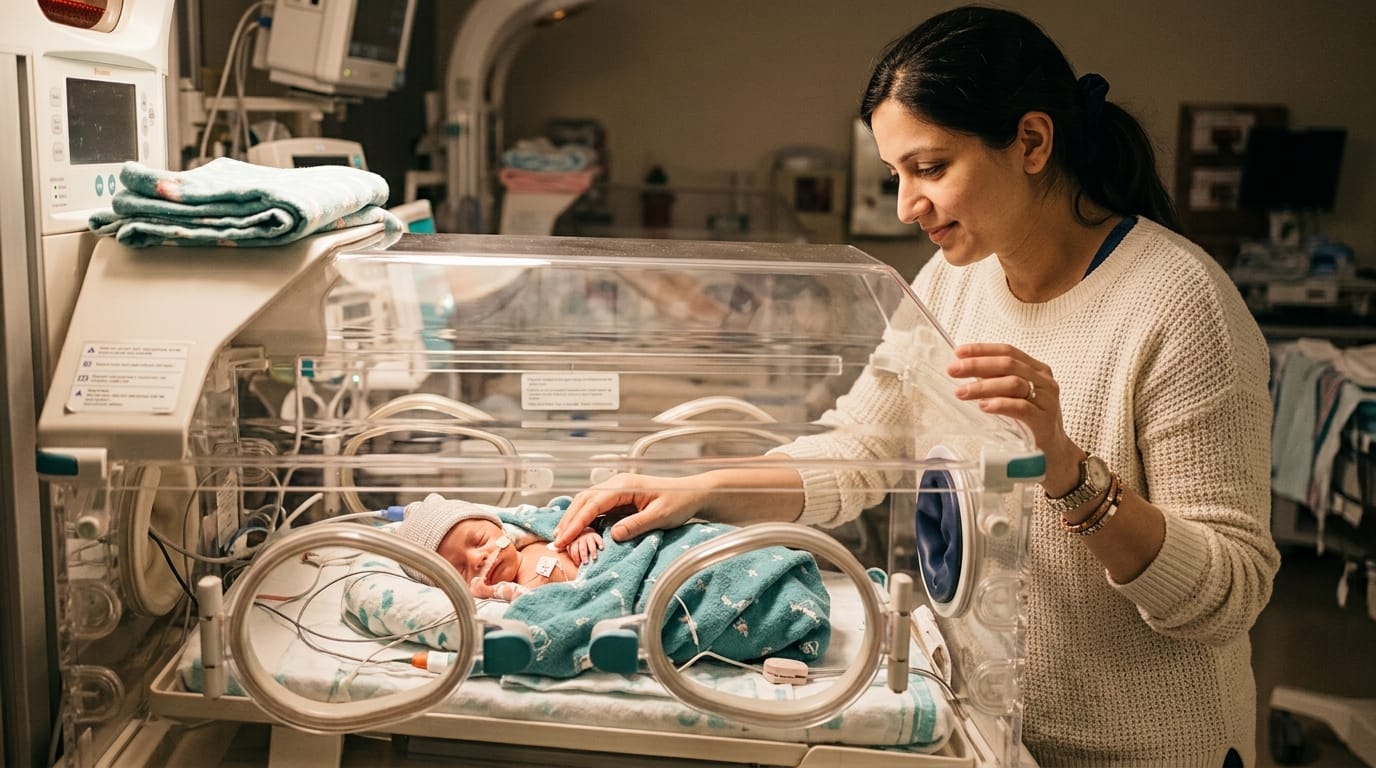
Nobody sat either of us down in the NICU to ask how we were doing. Every question, every check-in, every carefully worded update was about our son. That is exactly as it should have been — he needed it — but it also meant that the two of us went weeks without anyone naming what was happening to us as parents in the room next door to his incubator.
This Is a Genuinely Distinct Postpartum Experience
Ordinary postpartum depression and anxiety are already under-recognized and under-treated. Postpartum mental health after a NICU admission or an unexpected diagnosis like hydrocephalus is its own distinct experience layered on top — combining the usual hormonal and life-transition factors with acute medical trauma, a birth that may not have gone as expected, and an ongoing, unresolved fear about the baby’s future that does not simply resolve once you go home.
What the Research Actually Shows
According to PubMed, a large North American prospective cohort study following 3,559 participants from preconception through the postpartum period found an overall postpartum depression rate of 9.8% at six months, with very preterm birth (before 34 weeks) associated with a substantially higher risk — a relative risk of 1.88 compared with full-term birth (Nillni et al., Journal of Affective Disorders, 2025). The same study found the association between preterm birth and postpartum depression was notably stronger among parents with a prior history of mental health diagnoses, suggesting this population deserves more proactive screening, not less. A separate 2025 review specifically addressing parents after preterm birth noted that existing mental health interventions in this space remain heavily medicalized and infant-focused, with a real, acknowledged gap in emotionally-focused support designed specifically for parents themselves (Lloyd-Collins et al., Clinical Child and Family Psychology Review, 2025).

Depression, Anxiety, and PTSD Are Distinct — and Can Overlap
Postpartum depression involves persistent sadness, loss of interest, or hopelessness. Postpartum anxiety often shows up as intrusive, difficult-to-control worry, frequently focused specifically on the baby’s medical status. Post-traumatic stress disorder, increasingly recognized in NICU parents specifically, can involve flashbacks to traumatic medical moments, avoidance of hospital-related reminders, and a persistent heightened startle response — sometimes triggered, months later, by something as ordinary as a hospital smell or a monitor’s beep. These three conditions frequently overlap in the same parent, and naming which one (or which combination) you are experiencing can meaningfully shape which type of support actually helps.
Why the Standard Screening Question Often Misses This
Postpartum depression screening, when it happens at all, typically occurs at a single postpartum obstetric visit using a general tool like the Edinburgh Postnatal Depression Scale — a visit that may occur before, during, or well after a NICU stay, and one focused on the birthing parent specifically, often overlooking partners entirely. This structural gap means many NICU parents, especially partners, are never formally screened at all during the period when risk is highest.
A Different Way to Think About Support: Compassion-Focused Approaches
One promising direction highlighted in recent research moves beyond purely medicalized intervention toward compassion-focused approaches specifically addressing the shame, self-criticism, and grief that often accompany a traumatic birth or NICU stay — feelings that standard depression treatment frameworks do not always directly address. This does not replace medication or standard therapy when clinically needed, but it names something many NICU parents describe feeling and rarely hear addressed directly: a private sense of having somehow failed at the most basic task of keeping their baby safe, even when nothing they did caused the outcome.
What This Means for Your Family
If you are a parent currently in, or recently out of, a NICU stay or a sudden newborn diagnosis, and you notice persistent low mood, intrusive worry, or a sense of detachment that does not lift, this is common enough to have real research behind it — it is not a personal failure, and it is not something you are expected to simply push through. Both parents, not only the birthing parent, deserve to be asked directly how they are doing, and deserve to ask for that check-in themselves if nobody offers it first.

Questions to Ask Your Care Team
- Is there a formal postpartum depression or PTSD screening offered to both parents, not only the birthing parent?
- Are there NICU-specific parent support groups or therapists familiar with medical trauma at this hospital?
- What symptoms would indicate this has moved beyond typical adjustment and warrants a referral?
- Are there resources or support groups specifically for partners, who are frequently overlooked in screening?
- Is medication an option to discuss now, or is a referral to therapy the recommended first step?

Frequently Asked Questions About Postpartum Mental Health After a NICU Stay
Is it normal to feel traumatized after a NICU stay, even once the baby is medically stable?
Yes. Research increasingly recognizes PTSD symptoms specifically in NICU parents, and these feelings can persist well after a baby is medically stable and home.
Are partners also at risk, or is this mainly about the birthing parent?
Partners are also at real risk and are frequently under-screened, since standard postpartum depression screening tools and visits are typically structured around the birthing parent alone.
How is postpartum depression different from normal adjustment to a hard diagnosis?
Normal adjustment involves grief and stress that gradually eases. Postpartum depression involves persistent, often worsening symptoms — hopelessness, loss of interest, difficulty functioning — that do not resolve on their own and benefit from treatment.
Where can NICU parents specifically find support?
Many children’s hospitals now have NICU-specific parent support programs, and organizations like Postpartum Support International offer resources specifically for parents of medically complex newborns.
That unasked question in the NICU — how are you doing — is one I now ask other parents directly whenever I can, because I remember exactly how much it would have meant to be asked. If nobody has asked you yet, I am asking now: how are you doing, really?
This article is written for informational purposes only and does not constitute medical or mental health advice. If you are experiencing thoughts of harming yourself, please contact the 988 Suicide & Crisis Lifeline or seek immediate care. Always consult a qualified healthcare or mental health provider for guidance specific to your situation. Read our full medical disclaimer at braincarepath.com/disclaimer/
Bibliography
- Nillni YI, Schildroth S, Yland JJ, Brown HL, Wesselink AK, Wise LA. Association between adverse perinatal events and postpartum depressive symptoms in a North American prospective preconception cohort study. Journal of Affective Disorders. 2025;375:525-532. Available at: https://doi.org/10.1016/j.jad.2025.01.088
- Lloyd-Collins TM, Fitzallen GC, Kirby JN. A Compassion-Focused Approach to Support Parents After Preterm Birth. Clinical Child and Family Psychology Review. 2025;28(4):954-972. Available at: https://doi.org/10.1007/s10567-025-00549-z
- Postpartum Support International. NICU Families and Perinatal Mental Health. Available at: https://www.postpartum.net/