

VP Shunt Failure — How to Recognise It and What to Do Immediately
There is a moment that every parent of a shunted child carries in some corner of their mind. A quiet fear that does not announce itself — it just lives there. It sounds like: What if the shunt stops working?
This article is for that fear. Not to make it louder, but to replace it with information. Because the difference between recognising shunt failure early and missing it can be the difference between a planned revision surgery and a crisis. Read it once. Then share it with every adult in your child’s life who spends time with them.

What VP Shunt Failure Actually Is
A VP shunt is a mechanical device. Like all mechanical devices, it can fail. The valve can become blocked. The tubing can become kinked, disconnected, or dislodged as a child grows. The distal end (the peritoneal end in the abdomen) can develop adhesions. Infection can compromise the entire system.
Shunt failure does not always happen dramatically. It can be sudden — a child who was fine at breakfast who is limp by lunchtime. But it can also creep in over days: a child who seems a little off, a little more tired, a little more irritable. Both presentations are real. Both are emergencies.
The medical term is shunt malfunction. The practical term is: the fluid in your child’s brain is no longer draining properly, and pressure is building.

The Warning Signs — Know These by Heart
These are the symptoms of shunt malfunction. They can appear individually or together. The more of them present at once, the more urgently you must act.
Headache — This is the most common first symptom. Not a mild headache. A severe, persistent, or rapidly worsening headache, often worse in the morning or when lying flat. In young children who cannot describe pain, watch for inconsolable crying, holding the head, or apparent head sensitivity.
Vomiting — Repeated vomiting, particularly projectile vomiting, is a key warning sign. Especially when it occurs without fever or obvious stomach illness. Especially when it follows or accompanies a headache. Post-surgery vomiting in the first day or two is normal — vomiting weeks or months later is not.
Extreme drowsiness — More than tiredness. Difficulty waking your child, unusual sleepiness mid-day, slow responses to your voice or touch. In infants, a marked decrease in alertness or interaction.
Vision changes — Blurred or double vision, eyes appearing to look downward (sunsetting sign), complaints that things look different. In younger children who cannot articulate this, watch for them rubbing their eyes repeatedly or appearing unable to focus on faces.
Seizures — A new seizure in a child with a shunt, or a change in the pattern of seizures in a child who already has epilepsy, should always be assessed urgently in the context of shunt function.
Irritability and behaviour change — In infants and toddlers especially. A normally settled child who becomes persistently inconsolable, or a normally active child who becomes withdrawn, is communicating something.
Swelling along the shunt path — Redness, warmth, or swelling under the skin along the route of the shunt — behind the ear, down the neck, into the abdomen — can indicate infection or tubing problems.
Fever with no obvious source — Infection of the shunt system (shunt infection) is a serious complication requiring immediate treatment. Unexplained fever in a shunted child should always trigger a call to your neurosurgical team.
Head circumference increase in infants — In babies whose fontanelle (soft spot) is not yet fully closed, a bulging fontanelle or a rapidly increasing head circumference can indicate rising intracranial pressure.
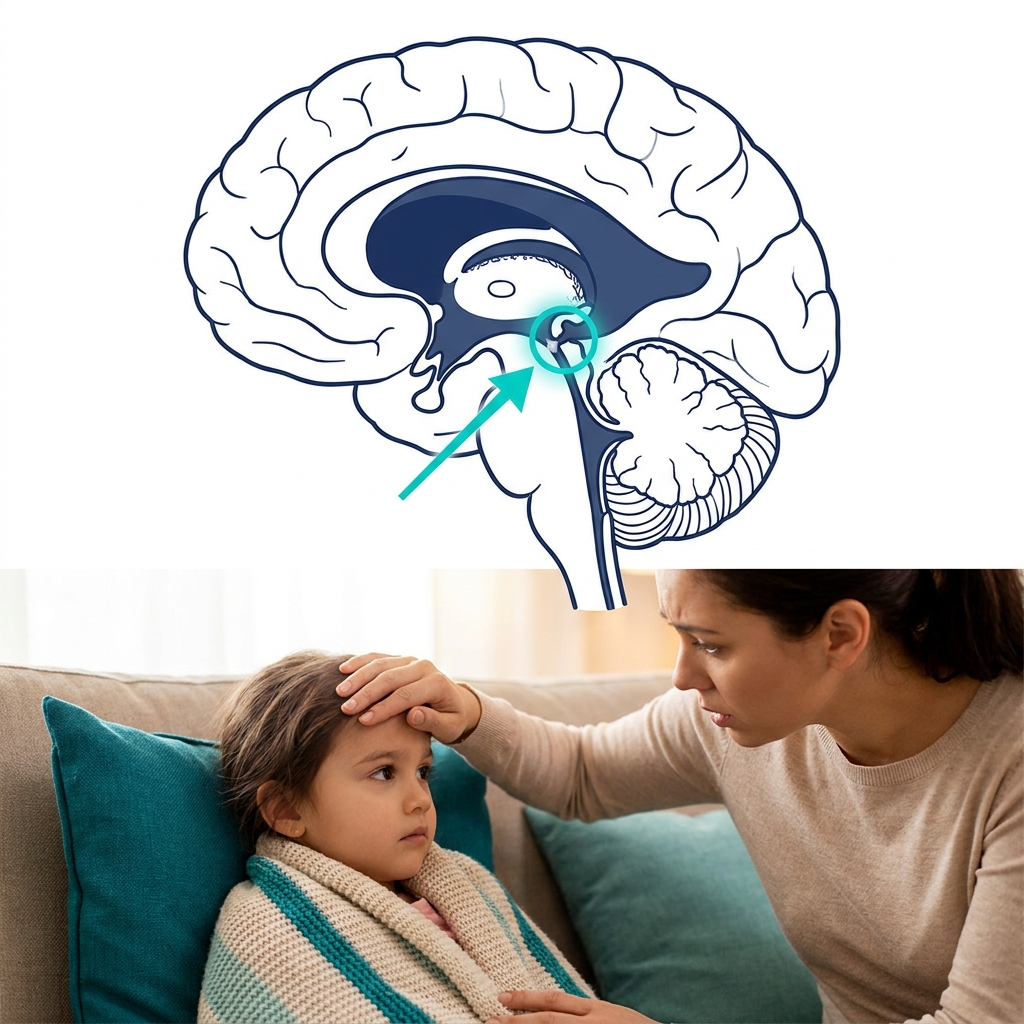
Go to Emergency Room Immediately If…
Do not call your GP first. Do not wait until morning. Do not search online for two hours. Go directly to the nearest emergency department if your child shows:
- A severe or rapidly worsening headache
- Repeated vomiting (more than twice) without obvious stomach illness
- Unusual drowsiness or difficulty waking
- Sunsetting eyes or vision complaints
- A new seizure or a change in seizure pattern
- Any combination of the above symptoms, even mild
When you arrive, say these words immediately: “My child has a VP shunt and I am concerned it may be failing.” This tells the triage nurse to escalate immediately. Do not allow this to be triaged as a general stomach complaint or headache. Advocate clearly.
Bring any shunt identification cards, surgical records, or the name of your child’s neurosurgical team. If you do not have these with you, that is still okay — just go.
What the Research Shows
A 2022 study by Hosainey et al. published in Neurosurgical Review found that VP shunt survival rates decline progressively over time, with failure risk present throughout the shunt’s lifespan — not just in the early post-operative period. A 2021 meta-analysis by Sobana et al. in Child’s Nervous System confirmed that untreated shunt failure carries significant risk of progressive neurological damage — underlining that early recognition and rapid treatment are the most important factors in outcome. Research consistently shows that parents and carers who are well-informed about warning signs are among the most reliable early detectors of shunt malfunction — more reliable, in many documented cases, than routine clinic assessments alone.
What This Means for Your Family
Living with a shunted child does not mean living in fear. Most shunts function well for years. Many children go through childhood, adolescence, and into adulthood without a single revision.
But the preparation matters. Know the signs. Make sure your partner knows them. Make sure grandparents, childminders, school staff, and anyone else who spends significant time with your child knows them too.
Create a simple card — or take a photo of this article — with the emergency symptoms and the words to say at triage. Keep it in your wallet, your phone, and in the school office. This is not catastrophising. This is practical love.
We have had more than one night where something felt off and we watched carefully. Most of those nights ended normally. But the one time it mattered — we went in. Trust that instinct. Always.

Questions to Ask Your Neurosurgical Team
- What are the specific failure signs most common for the type of shunt my child has?
- Is there a shunt clinic or direct number for urgent out-of-hours concerns?
- How quickly does shunt malfunction typically progress in a child my child’s age?
- Is my child at higher than average risk of early failure given their diagnosis?
- Does my child’s programmable valve need to be checked after any MRI scans?
- Should my child carry a shunt identification card at all times?
- What should I say when I arrive at A&E with a suspected shunt failure?
- How often should my child have routine shunt function monitoring?
You will know your child better than any textbook can describe them. When something feels wrong, it usually is. This knowledge — this vigilance — is not a burden. It is the thing that keeps them safe.
Go in. Ask the question. Let them rule it out. That is always the right call.
This article is written for informational purposes only and does not constitute medical advice. Always consult your neurologist, pediatrician, or qualified healthcare provider for diagnosis and treatment decisions specific to your situation. Read our full medical disclaimer at braincarepath.com/disclaimer/
- Hosainey SAM, Lykkedrang BL, Meling TR. Long-term risk of shunt failure after brain tumor surgery. Neurosurg Rev. 2022;45(2):1589-1600. Available at: https://pubmed.ncbi.nlm.nih.gov/34713351/
- Sobana M, Halim D, Aviani JK, Gamayani U, Achmad TH. Neurodevelopmental outcomes after ventriculoperitoneal shunt placement in children with non-infectious hydrocephalus: a meta-analysis. Childs Nerv Syst. 2021;37(4):1055-1065. Available at: https://pubmed.ncbi.nlm.nih.gov/33479825/
- Sanderfer VC, Arnold MR, Mulvaney GG, et al. Outcomes of laparoscopic and open ventriculoperitoneal shunt placement. Am J Surg. 2024;227:123-126. Available at: https://pubmed.ncbi.nlm.nih.gov/37827869/